
Attention is harder to earn than ever. A business podcast gives people a reason to slow down, listen, and trust the humans behind your brand. In this article, we’ll look at the real benefits of a podcast for business, how podcasting fits into a wider content strategy, who should host your show, and how purpose-driven brands can turn one strong conversation into long-term marketing value.
Benefits of a Podcast for Business
The benefits of a podcast for business go far beyond brand awareness. A good show can support trust, authority, search visibility, lead generation, customer education, social media, events, partnerships, and sales conversations. That is why more companies now treat podcasts as part of a serious content strategy, not a side project.
For Humanise Live’s audience, the value is not just reach. It is relevant. A sustainability brand, charity, social-impact fund, or B2B SaaS company often needs to explain why its work matters before it can ask people to act. A podcast gives that explanation room to breathe, while video clips, transcripts, show notes, and event content help the same message travel further.
| Benefit | Why It Matters |
| Trust | Helps people hear the humans behind the brand |
| Authority | Turns expertise into visible thought leadership |
| Content | Creates blogs, clips, newsletters, and sales assets |
| SEO | Supports search through transcripts and show notes |
| Leads | Warms up prospects before sales conversations |
| Relationships | Opens doors with guests and partners |
| Brand voice | Makes the company feel more human |
| Video | Feeds YouTube, reels, and social channels |
| Events | Extends the life of panels, webinars, and talks |
| Host visibility | Builds recognition around founders or experts |
| Consistency | Keeps the brand present over time |
Podcast listening is no longer a niche habit. Edison Research reported that in 2025, 73% of Americans aged 12 and older had consumed a podcast, 55% had done so in the past month, and 40% had done so in the past week. Time spent with podcasts among people aged 13 and older had also grown 355% since 2015, reaching 773 million hours per week.
The numbers tell a clear story: people are not just sampling podcasts; they are building them into their routines. For businesses, that creates a rare opening. Instead of fighting for a two-second scroll, a podcast episode can hold attention long enough to explain a complex idea, introduce a guest, answer a real objection, or make a brand feel familiar before a sales conversation ever starts.
For brands that need help with planning, recording, editing, and releasing, professional podcast production support can turn a loose idea into a clear, consistent show.
1. A Podcast Builds Trust Faster Than Most Marketing Channels
People do not only hear the words in a podcast. They hear the thinking behind them. They hear warmth, doubt, humor, care, confidence, and pace. That makes podcasting feel different from most written marketing.
A landing page can explain what a company does. A podcast can show how its people think. That is a major reason the benefits of a podcast for business are so closely tied to trust. When a listener hears the same host or team return with useful conversations, the brand starts to feel familiar. Familiarity lowers friction. It makes sales calls warmer, referrals easier, and complex ideas simpler to explain.
Research with Nielsen shows that 63% of people view podcast hosts they listen to as trustworthy, while 80% trust recommendations from those hosts. Signal Hill 2024 Benchmark Report found that 86% of the branded podcasts it tested resulted in a lift in brand affinity.
| Trust Driver | Why It Helps a Business |
| Voice | Listeners hear real people, not polished slogans |
| Consistency | Regular episodes build familiarity over time |
| Expertise | Useful conversations show what the business knows |
| Guests | Credible guests can strengthen authority |
| Story | Human stories make values easier to remember |
For teams still at the idea stage, learning how to start a podcast offers a practical next step.

2. Business Podcasts Turn Expertise Into Authority
Every business says it has expertise. A podcast gives people the chance to hear it. That matters for founders, CEOs, consultants, charities, NGOs, sustainability brands, tech-for-good companies, B2B SaaS teams, and social-impact funds. These organizations often sell ideas before they sell products or services. They need people to trust their view of the problem.
A podcast helps because it gives experts room to explain context. A business owner can talk through a hard decision. A charity leader can explain what is really happening behind a campaign. A software founder can unpack a buyer’s problem without reducing it to a sales pitch. A thought leader can take a subject that feels dry on paper and make it clear in conversation.
The benefits of a podcast for business become stronger when the topic is complex, emotional, or high-trust. Short-form content can start the conversation. Long-form audio can deepen it.
| Business Type | How a Podcast Builds Authority |
| B2B SaaS | Explains buyer problems before a sales call |
| Charity or NGO | Tells the human story behind the mission |
| Sustainability brand | Educates without sounding preachy |
| Founder-led company | Builds trust around the person behind the brand |
| Social-impact fund | Shows values, thinking, and sector insight |
For specialist companies that sell to other organizations, B2B podcast production can help turn expert knowledge into a show that supports sales, partnerships, and brand authority.
3. Podcasts Offer a Content Engine, Not Just an Audio Show
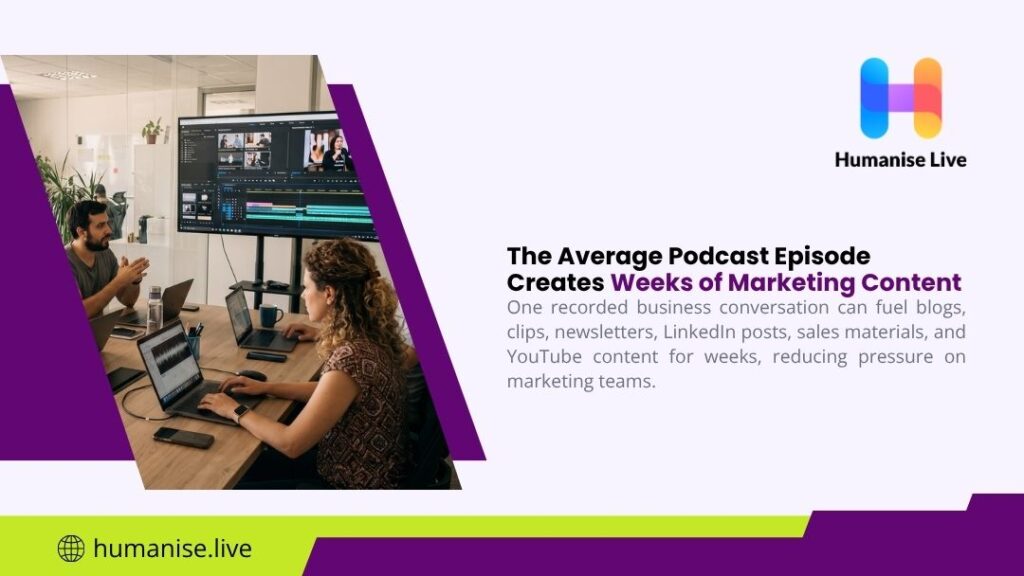
A podcast episode should not live and die as one audio file. That is where many businesses miss the real value. One strong conversation can become a blog post, a newsletter, a LinkedIn article, several short social media clips, a YouTube video, sales enablement content, quotes for a campaign, and a transcript that supports search.
This is one of the most practical benefits of a podcast for business because it helps teams get more value from the time they already spend with customers, guests, leaders, and experts.
This matters even more for small marketing teams. Most teams are not short of opinions. They are short of usable content. A podcast gives them a repeatable source.
| Original Asset | Repurposed Content |
| One podcast episode | Blog post, transcript, newsletter, LinkedIn post, short clips, quote graphics, YouTube video, sales asset |
| One event panel | Podcast episode, highlight reel, guest clips, article, email campaign |
| One customer conversation | Video testimonial, social proof clips, FAQ content, case-style story |
| One expert interview | SEO article, AI-search-friendly transcript, founder post, internal training clip |
This is where podcasting starts to beat a single-channel content plan. A blog post can rank, but it may not show personality. A social post can travel quickly, but it disappears quickly, too. A webinar can educate, but it often gets forgotten after the event. A podcast can sit underneath all of those channels as the source material.
| Channel | Strength | Limitation | Where a Podcast Helps |
| Blog posts | Search visibility | Less personal | Adds voice and depth |
| Social media | Fast reach | Short attention span | Gives clips a deeper source |
| Webinars | Good education | Often one-off | Can become evergreen episodes |
| Events | High trust | Limited by time and place | Extends the conversation after the event |
| Direct audience access | Needs strong content | Uses episodes as recurring material |
The workflow does not have to be complicated. A team can choose one clear theme, record one focused conversation, edit the full episode, create a transcript, write show notes, cut short clips, and turn the strongest ideas into blog posts, email content, and social media assets. That is much easier than starting from a blank page every week.
| Production Step | Business Value |
| Plan the theme | Keeps the episode tied to a business goal |
| Record the conversation | Captures expert insight in a natural format |
| Edit the full episode | Makes the show easier to listen to |
| Create a transcript | Supports SEO, accessibility, and repurposing |
| Write show notes | Helps listeners and search engines understand the topic |
| Cut clips | Feeds social media and video channels |
| Review performance | Shows what topics deserve more attention |
For brands that want each episode to work harder, getting more value from each podcast episode is a practical addition to a workflow. Teams that need broader campaign support can also consider podcast marketing services.
This is where many teams need support. They do not lack ideas; they lack the production system to turn those ideas into finished episodes, clips, transcripts, and campaigns. A done-for-you production partner can protect the team’s time while keeping the show consistent.
4. A Business Podcast Can Support SEO and AI Search Visibility
A podcast does not improve SEO just because it exists. Search engines cannot rank a vague audio file as easily as a useful written page. But when a podcast is planned properly, it can support Google visibility and AI search in a very practical way. The key is to turn spoken expertise into structured content.
| SEO Asset | Why It Matters |
| Transcript | Gives Google and AI tools text to understand |
| Show notes | Summarizes the value of each podcast episode |
| Internal links | Connects podcast topics to relevant services |
| Blog posts | Turns spoken insight into searchable content |
| YouTube uploads | Adds another discovery channel |
| Guest entities | Builds topical depth and authority |
This is one reason the benefits of a podcast for business now extend beyond audio. A well-produced show can feed search, social, video, email, and AI answer engines when the content is clear and well-structured.For this part of the workflow, podcast transcription services can help turn the recording into search-ready text. Teams that care about search visibility can also explore whether having a podcast helps SEO and GEO.
5. Podcasts Help Brands Build Better Relationships
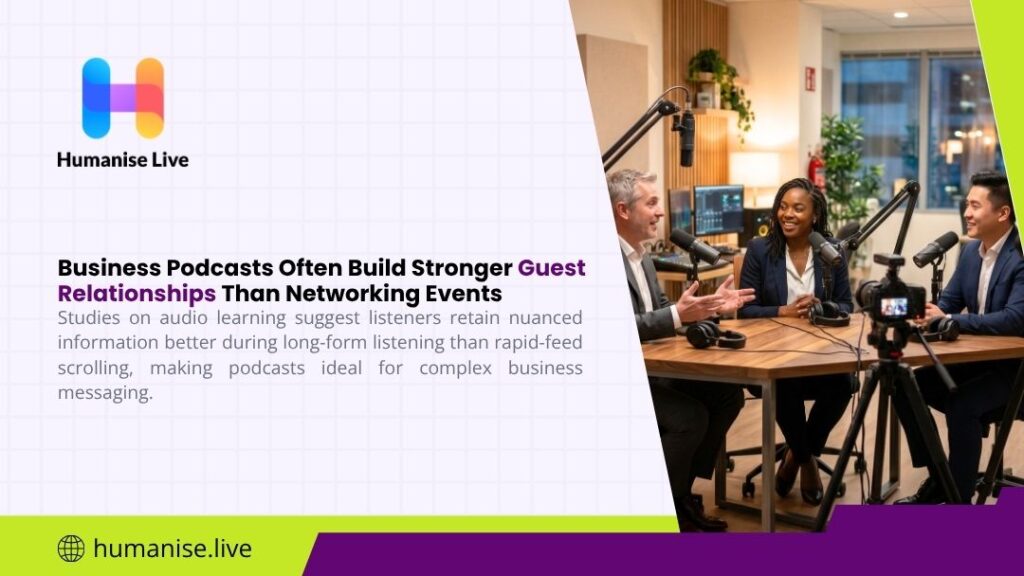
A podcast gives a business a reason to start better conversations. Instead of asking a prospect for a sales call, a company can invite them to share expertise. Instead of sending a cold networking message, a founder can invite a guest onto a thoughtful show. Instead of treating partners as names in a CRM, the business can create something useful with them.
That is not a small advantage. Many of the best business opportunities start as conversations before they become contracts.
Wistia’s Sylvie Lublow, producer of Talking Too Loud, put it well: Every podcast episode extends our network and positions us as part of a broader, creative business conversation.
For purpose-driven companies, this can be especially powerful. A guest may become a partner, donor, investor, referral source, speaker, advocate, or future client. The podcast becomes a relationship tool as much as a media channel. A practical next step is to build a guest plan before recording. Guidance on how to find podcast guests can support that process.
6. Podcasting Gives Purpose-Driven Brands a Human Voice
Purpose-driven organizations often have strong missions but complex messages. A charity may need to explain a sensitive social issue. A sustainability company may need to talk about systems, behavior, supply chains, or regulation. A tech-for-good brand may need to prove that the problem is real before anyone cares about the product.
A podcast gives those ideas breathing room. That does not mean every episode has to be serious or heavy. In fact, the best business podcasts often feel clear, warm, and grounded. They make complex ideas easier to understand by putting people at the center.
For organizations that want a polished company show, corporate podcast production can help shape the message, production quality, and release plan.
7. A Podcast Can Help Generate Leads, But Not in the Usual Way
Podcasting is rarely a quick-click sales channel. That is not a weakness. It simply works differently. A paid ad may create a fast lead. A podcast often creates a warmer one. The listener has spent time with your voice, your ideas, your guests, and your point of view. By the time they contact you, they may already understand how you think.
That is why the benefits of a podcast for business often show up across the whole buyer journey. A podcast can introduce the brand, educate the buyer, answer objections, strengthen trust, and keep the company visible between sales conversations.
Adobe Express reported that 16% of business owners had launched a podcast, 11% planned to launch one by year-end, 78% said their podcast met or exceeded ROI expectations, and businesses reported an average 38% revenue increase after a launch.
| Lead Path | How It Works |
| Guest-led leads | Guests become partners, clients, or referrers |
| Search-led leads | Episodes become searchable articles and transcripts |
| Trust-led leads | Listeners feel familiar with the brand before contact |
| Event-led leads | Live panels and talks become follow-up content |
| Social-led leads | Clips bring people back to the full episode or website |
If paid amplification is part of the plan, a strong podcast advertising strategy can help the show reach the right listeners instead of relying only on organic discovery.
8. Podcasts Work Well With Video, Reels, and Event Content
Business podcasts are no longer audio-only by default. Many are now recorded on video, posted on YouTube, cut into short clips, used in newsletters, shared on LinkedIn, and repurposed after events.
This is one of the clearest benefits of a podcast for business in 2026. A single recording session can support multiple channels without forcing the team to create from scratch every week.
A founder interview can become a full podcast episode, three short video clips, a blog post, a newsletter opener, a quote card, and a sales follow-up link. An event panel can become an episode, a recap video, guest clips, and a campaign asset. A webinar can become a more polished thought-leadership series.
Events take time, budget, speakers, planning, and audience attention. Yet many companies let the value disappear once the room clears or the livestream ends. A podcast helps that work last longer. A panel discussion can become an episode. A keynote can become a short series. A speaker interview can become social clips, newsletter content, and follow-up sales material.
This is especially useful for purpose-driven organizations. A charity campaign, sustainability panel, or tech-for-good discussion may contain stories and insights that deserve a longer shelf life than a single event page.
Humanise Live’s services reflect this wider content model. The company supports podcast production, video and reels, event capture and livestream, speaker representation, content repurposing, and campaign management.
For distributed teams, remote podcast recording can make high-quality interviews possible even when the host, guest, and producer are in different places. If video is part of the plan, podcast video editing can help shape raw conversations into usable clips and full episodes.
9. The Right Host Can Make the Business More Memorable
The host is not just the person who asks questions. The host shapes the tone of the show. They guide the guest, protect the listener’s time, explain the topic, and give the brand a recognizable voice.
This is where many companies get stuck. A leader may want to start a podcast, but no one inside the organization feels like the obvious host. Some teams then think they need a professional presenter, a radio host, or an external interviewer.
Sometimes that works. Sometimes it is not needed. The better question is not who sounds most polished? It is who can help the listener trust this conversation?
| Host Model | Best For | Main Risk |
| Internal host | Founder-led, mission-led, expert-led companies | May need coaching and confidence |
| External host | Sensitive topics, polished formats, busy leadership teams | Can feel less connected to the brand |
| Two regular hosts | Shows that need chemistry and pace | Roles must be clear |
| Rotating panel | Larger organizations with several experts or themes | Listener familiarity can suffer |
To better understand this decision, compare internal vs external podcast hosting, explore who should host a podcast, or learn how to choose the right podcast host for your business.
10. Consistency Keeps the Brand Present Over Time
A podcast rarely works because of one great episode. It works because the audience starts to expect the next one. Consistency builds recognition. Recognition builds trust. Trust creates more room for sales, referrals, partnerships, invitations, and long-term brand growth.
That does not mean every business must publish weekly forever. Some companies are better suited to seasons. Others may prefer a monthly thought-leadership show. Some may use podcasts around campaigns, events, or product launches. The right rhythm is the one the team can maintain without letting quality slip.
This is where done-for-you production can protect the show from burnout. If production time is already a concern, focusing on how to speed up podcast production can help streamline the process.
11. A Podcast Helps the Brand Sound More Human
Many companies struggle to sound human online. Their website is polished. Their social posts are short. Their emails are edited until every rough edge disappears. That may be tidy, but it can also feel distant. A podcast gives the brand a voice people can recognize.
For a business owner, that voice might be thoughtful and practical. For a charity, it might be compassionate and clear. For a B2B SaaS company, it might be calm, expert, and useful. For a sustainability brand, it might help explain complex work without turning every message into a lecture.
This is why hosting a podcast can support more than marketing. It can shape how people understand the company. Listeners begin to hear the values, priorities, and people behind the business. Over time, that can make the brand feel less like a supplier and more like a trusted voice in its space.
Is a Podcast Worth It for Every Business?
No. And saying so builds more trust than pretending every company needs one. The benefits of a podcast for business are strongest when the company has a clear audience, useful ideas, access to guests or experts, and enough patience to build over time. A podcast may not be the right move if the business only wants fast sales, has no clear point of view, or cannot commit to a regular production rhythm.
| A Podcast May Work If… | A Podcast May Not Work Yet If… |
| You have expertise that customers care about | You only want quick sales |
| Your audience values long-form content | You do not know who the show is for |
| You can commit to a consistent format | You have no time for planning or review |
| You can repurpose episodes into other content | You expect audio alone to carry the strategy |
| You have access to guests or internal experts | You do not have a clear topic or point of view |
The best business podcasts usually start with one simple decision: what should this show help our audience understand better? Once that answer is clear, the format becomes easier. The host choice becomes easier. The guest list becomes easier. Even the call to action becomes less awkward because the show has a real purpose.
For teams that want to avoid rushed, reactive production, planning podcast content helps create a more stable and consistent publishing rhythm.
FAQs About the Benefits of a Podcast for Business
What are the main benefits of a podcast for business?
The main benefits of a podcast for business include stronger trust, better authority, deeper audience relationships, more content from one idea, improved search visibility when transcripts and show notes are used, and more natural lead generation through expertise and guest relationships.
Can a podcast help my business get more leads?
Yes, but not always in the same way a paid ad does. A podcast usually helps generate leads by making the business more familiar, more trusted, and easier to understand. It can also create warmer introductions through guests, partners, and shared content.
Does a podcast help with SEO?
A podcast can help SEO when it is supported by transcripts, show notes, blog posts, internal links, structured topics, and clear episode pages. Audio alone is not enough. The search value comes from turning spoken expertise into useful, indexable content.
Should my business podcast have a professional host?
It depends on the goal of the show. An internal host may feel more authentic because they understand the organization from the inside. An external host may add polish, pace, and interview skills. A co-hosted format can add chemistry, while a rotating panel can work for larger organizations with several experts.
Are podcasts worth it for small businesses?
Podcasts can be worth it for small businesses when the audience needs education, trust, or expert guidance before buying. They work especially well for founder-led companies, service businesses, consultants, B2B brands, and purpose-driven organizations with strong ideas but limited time to create content from scratch.
How long does it take for a business podcast to grow?
Growth depends on the niche, audience, quality, consistency, guests, promotion, and repurposing plan. Some shows build traction through guest networks and social clips. Others grow through search, YouTube, newsletters, or community sharing. The key is to treat the podcast as a long-term content asset, not a one-off campaign.
What should my first business podcast episode be about?
The first episode should explain who the show is for, what problem it helps solve, why the topic matters, and what listeners can expect next. A clear first episode gives people a reason to return.
A Business Podcast Works Best When It Has a Purpose
The benefits of a podcast for business are strongest when the show has a reason to exist. It should not be there because competitors have one. It should help the right people understand something important, trust the people behind the brand, and return for more useful conversations.
For purpose-driven companies, that means more than clean audio. It means a clear message, a human voice, a practical format, and a plan to turn every episode into content that keeps working across search, social media, video, events, and sales.
A business podcast can build authority. It can create trust. It can support SEO and AI search. It can make events last longer. It can help founders and teams become known for what they know. But only when the strategy is sound, and the production supports the message. If your team has the ideas but not the time, structure, host confidence, or production workflow, Humanise Live can help shape the strategy, record the conversations, manage the guests, edit the episodes, and turn each show into content for the channels your audience already uses. Start with professional podcast production and build a show that sounds human, useful, and worth coming back to.
