
Does having a podcast help with SEO and GEO? The short answer is yes, but only when it’s approached as a structured content strategy, not just a recording exercise. Podcasts can expand your digital footprint, improve search engine visibility, and increasingly influence how AI-driven search surfaces your brand. Here’s what actually makes the difference.
For purpose-driven organizations, this matters even more. A podcast isn’t just content, it becomes a long-term asset that builds trust, credibility, and meaningful engagement.
This article aims to explain how podcast SEO actually works in 2026 and what separates podcasts that rank from those that stay invisible.
Does Having a Podcast Help with SEO and GEO?
It does, but not in the way most people assume. A podcast on its own won’t suddenly push your website to the top of search engine results. What it does is create a steady stream of content assets, audio, text, and video, that search engines and AI systems can understand, index, and reuse.
Search engine optimization has shifted. It’s no longer about isolated blog posts. It’s about ecosystems. A podcast becomes part of that system. Each episode adds new keywords, fresh context, and topical authority.
GEO, or generative engine optimization, goes a step further. Platforms powered by AI, think conversational search, pull from structured, human-sounding content. Podcast conversations naturally align with that format. And that’s where things get interesting, because suddenly your podcast isn’t just content, it’s part of how search engines and AI understand your expertise.
How Do Podcasts Improve Search Engine Visibility?
Search visibility improves when content answers real questions in natural language. Podcasts do this almost by default.
Content Volume and Indexable Assets
A single podcast episode rarely stays as one piece of content. It becomes a cluster, an episode page, show notes, snippets, clips, and supporting materials. Each of these adds to your indexed footprint.
| Content Layer | SEO Benefit |
| Episode page | Targets primary keyword |
| Show notes | Expands topical coverage |
| Blog summary | Captures long-tail queries |
| Clips and snippets | Drives external traffic |
One podcast episode doesn’t equal one piece of content; it can become five or more SEO assets. Think of it like this:
| Asset Type | Purpose |
| Full episode page | Core ranking page |
| Transcription | Keyword indexing |
| Blog summary | Long-tail traffic |
| Video clips | Social discovery |
| Quote snippets | Backlink potential |
This 1 episode = 5 assets approach is where podcast SEO starts compounding rather than plateauing. Businesses that invest in structured podcast production through platforms like Humanise Live often see this layered approach produce steady growth rather than isolated spikes.
Keyword Expansion Through Conversations
Podcast discussions naturally introduce phrases that keyword tools often miss. When people speak, they don’t follow keyword formulas; they ask questions, explain ideas, and explore nuances. This creates a wider semantic field. Over time, your podcast content begins to rank for variations you didn’t deliberately target. This is why seo for podcasts often outperforms traditional blog strategies over time, because conversations naturally match how people actually search.
Backlinks and Authority Signals
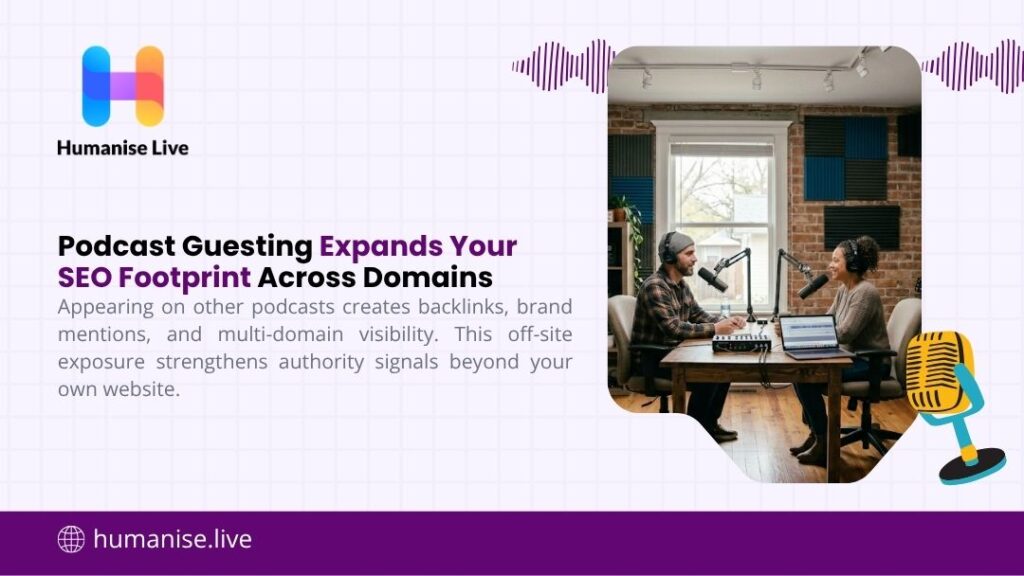
Podcasts tend to generate links without forced outreach. Guests share episodes. Partners reference them. Mentions appear across blogs and social platforms. These signals strengthen your domain’s credibility. Search engines read this as trust. And trust often leads to better rankings.
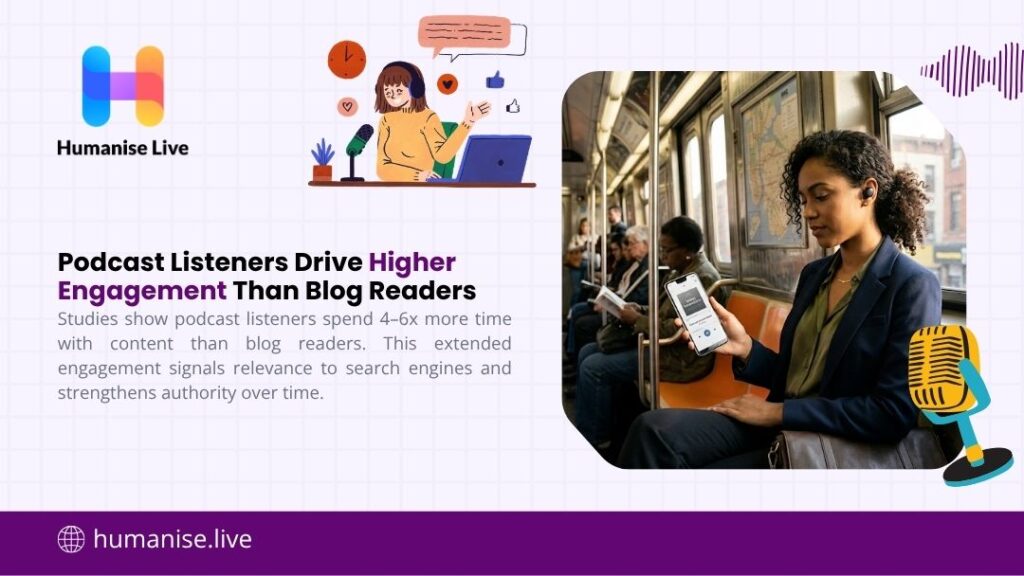
According to Edison Research, 88% of podcast listeners say they take action after hearing an ad or message on a podcast, highlighting the high level of trust and engagement within the medium.
That level of engagement often leads to more shares, mentions, and backlinks, signals that search engines use to evaluate authority and relevance.
The Role of RSS Feed SEO in Podcast Rankings
RSS SEO (Really Simple Syndication for Search Engine Optimization) often gets overlooked, but it quietly underpins podcast discoverability. RSS feeds tell platforms how to interpret your content. Episode titles, descriptions, categories, and metadata all influence visibility across directories and search engines.
When structured correctly, RSS feed SEO ensures your podcast appears in both traditional search and platform-specific discovery engines like Apple Podcasts or Spotify. The difference between a podcast that gets discovered and one that doesn’t often comes down to how well its feed is structured.
RSS and SEO are more connected than most people think. Your RSS feed acts as the backbone of distribution, feeding structured data into platforms and search engines. When optimized correctly, RSS and seo work together to improve discoverability across both podcast apps and web search.
Podcast SEO vs Traditional SEO: What’s Different?
Podcast SEO doesn’t replace traditional SEO. It expands it. The two approaches overlap, but they operate in different ways.
| Element | Traditional SEO | Podcast SEO |
| Content format | Written text (Blogs, web pages, Articles) | Audio with supporting text (Metadata + Transcripts + Audio file + Show Notes). |
| Indexing | Direct crawling | Requires transcription |
| Engagement signal | Time on page | Listen duration |
| Keyword usage | Planned insertion | Natural conversation |
| Distribution | Website-focused | Multi-platform ecosystem |
The key difference lies in accessibility. Audio alone isn’t enough. Without text support, search engines struggle to understand the content. That’s why services like a podcast transcription service become essential rather than optional.
How Podcasts Help GEO (AI Search & Generative Engines)
AI search doesn’t operate like traditional search engines. It doesn’t just rank pages, it synthesizes answers.
AI Pulls From Conversational Content: Podcasts mirror human dialogue. This makes them highly compatible with AI-generated responses. And here’s the thing, AI systems don’t just look for keywords anymore. They look for context. Podcasts provide that context in a way static content often can’t.
Entity-Based SEO Advantage: Names, topics, brands, and themes discussed in episodes form structured entities. These entities help AI systems connect your content to broader knowledge graphs. Over time, repeated mentions of topics, brands, and ideas strengthen your position within search ecosystems. This is how podcast content contributes to long-term topical authority.
Multi-Format Content Wins: Audio becomes text. Text becomes snippets. Snippets feed AI responses. This layered approach increases visibility across multiple channels. For brands focused on impact rather than volume, this approach allows one meaningful conversation to reach audiences across multiple channels without diluting the message.
Why Most Podcasts Fail to Rank
The issue isn’t quality. Its structure. Many podcasts sound great but remain invisible because they lack SEO foundations.
| Missing Element | Impact on Rankings |
| No transcription | Content not indexable |
| Weak titles | Low keyword relevance |
| Inconsistent publishing | Reduced crawl frequency |
| No internal links | Limited site authority |
In many cases, it’s not a lack of effort; it’s a lack of structure. Content gets published, but it isn’t positioned to be found.
Without these elements, even the best conversations struggle to reach an audience. That’s why businesses often move toward structured podcast marketing services rather than handling everything in-house.
Podcast SEO Best Practices That Actually Work
Effective podcast SEO starts with planning, but more importantly, it requires consistency and clarity. These podcast seo tips aren’t complicated, but they do require intention. Topics should align with audience intent. Episode titles need to reflect real search intent. Show notes should provide context, not filler. Transcriptions must be clean and readable. Internal linking should connect episodes to broader topic clusters. A well-executed podcast becomes part of a larger content network, rather than a standalone channel.
The Power of Transcriptions in Audio SEO
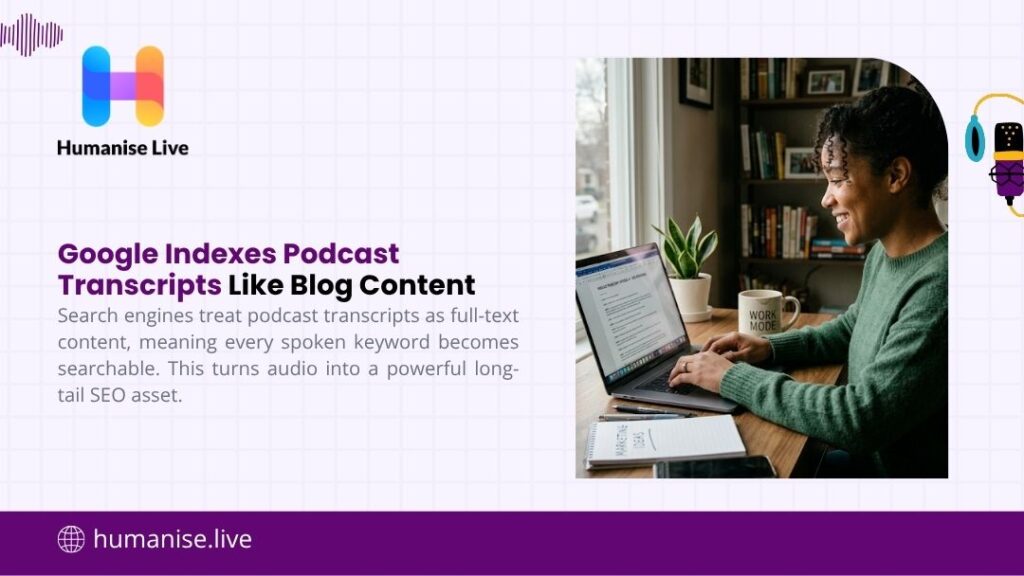
Search engines rely on text. Transcriptions convert spoken content into a format that can be indexed, analyzed, and ranked. This process does more than improve visibility. It allows your podcast to rank for phrases mentioned naturally in conversation.
According to Backlinko, content that matches search intent and includes relevant keywords tends to perform better because search engines can fully interpret it.
Transcriptions bridge that gap between audio and search visibility. Without them, much of your content remains hidden. Google itself has stated that structured, crawlable text improves how content is understood and ranked. This is why audio seo without transcription rarely performs at its full potential.
How Podcast Content Drives Long-Term Organic Growth
Podcast SEO doesn’t deliver instant results. It builds momentum over time.
| Timeframe | Impact |
| First 3 months | Initial indexing and visibility |
| 3–6 months | Traffic growth through search queries |
| 6–12 months | Authority building and consistent rankings |
Unlike paid campaigns, podcast SEO compounds. Each episode adds weight to your domain.
Does Podcasting Help Local SEO and Geo Visibility?
Podcasts can support local SEO when they include relevant geographic signals.
| Strategy | Local Impact |
| Mentioning locations | Improves regional relevance |
| Featuring local guests | Builds local authority |
| Covering regional topics | Targets location-based queries |
Local signals strengthen your presence in specific areas, especially when combined with consistent content.
Internal vs External Podcast Hosts: SEO Impact
Choosing a host affects more than tone. It influences discoverability and authority. A recent discussion with a business leader highlighted a common concern. They wanted to launch a podcast but didn’t have a clear internal host. The idea of hiring a professional presenter came up. It sounds appealing, but it raises questions.
| Hosting Model | SEO Impact | Brand Impact |
| Internal host | Strong authority signals | High authenticity |
| External presenter | Weaker brand connection | Professional delivery |
| Duo format | Higher engagement | Conversational tone |
| Rotating panel | Broader topic coverage | Less consistency |
In practice, audiences respond better to voices that feel connected to the brand. That doesn’t mean polished delivery isn’t useful. It just means authenticity tends to win.
When deciding who should host a podcast, the focus should be on someone who reflects the brand’s perspective naturally, communicates with clarity, and can build a consistent connection with listeners.
How to Optimize Your Podcast for Maximum SEO Impact
Optimization works best when applied at every stage.
| Step | Action |
| Planning | Choose topics based on search intent |
| Recording | Maintain a clear structure |
| Publishing | Add detailed show notes |
| Distribution | Share across platforms |
| Analysis | Track performance and refine |
If you’re exploring how to start a podcast, it helps to begin with the basics. A clear structure and consistent publishing schedule can make the process smoother.
For ongoing support, professional podcast services can simplify production tasks like editing, distribution, and sound optimization, helping maintain quality and consistency over time.
Common Mistakes That Hurt Podcast SEO
Even well-produced podcasts can underperform due to simple oversights.
| Mistake | Result |
| Generic titles | Low visibility |
| Thin descriptions | Poor indexing |
| No internal links | Weak authority |
| Irregular publishing | Reduced trust |
These mistakes aren’t unusual. In fact, most podcasts make at least one of them early on. The difference comes down to how quickly they’re identified and fixed. Fixing these areas often leads to noticeable improvements.
FAQs about Podcast Help with SEO and GEO
How Long Does It Take for Podcast SEO to Work?
Results don’t appear overnight. Most podcasts begin to see traction within three to six months. Consistency plays a major role. Regular publishing builds trust with both audiences and search engines.
When Podcasting Is Worth It for SEO?
Podcasting delivers the strongest results for brands that rely on trust and authority. B2B companies, thought leaders, and mission-driven organizations benefit most. Their audiences value depth, which podcasts naturally provide.
Is Podcasting Still Worth It in 2026?
Search has changed. AI-driven discovery is rising. Content formats are evolving. But here’s the thing. Human conversations still matter. In fact, they matter more than ever. Podcasts offer something written content often lacks, context, tone, and nuance. These qualities align closely with how modern search systems interpret information.
Is SEO dead or evolving in 2026?
SEO is evolving. Traditional ranking factors still matter, but AI-driven search now plays a larger role in how content is discovered.
What is the 80/20 rule for SEO?
The principle suggests that a small portion of your content often drives the majority of traffic. Focus on high-impact topics.
Will AI replace SEO?
AI won’t replace SEO, but it will reshape it. Optimization now includes preparing content for both search engines and AI systems.
Is SEO replacing GEO in 2026?
No. SEO and GEO work together. SEO supports rankings, while GEO influences how content appears in AI-generated answers.
Can ChatGPT do SEO?
AI tools can assist with research and drafting, but strategy, intent alignment, and human judgment remain critical.
What are the 3 C’s of SEO?
Content, context, and credibility. These elements determine how well your content performs in search.
What This Means for Your Content Strategy Moving Forward
Does having a podcast help with SEO and GEO? Yes, when it’s treated as part of a broader content system. It won’t replace traditional SEO. It strengthens it.
If you want your podcast to do more than just exist, to actually drive visibility, authority, and measurable growth, working with a team that understands both strategy and storytelling can make the difference.
You can explore how that approach works through Humanise Live and their full range of services. Because at the end of the day, it’s not about having a podcast. It’s about what you do with it.
