
If you’re asking how long does it take to grow a podcast, the honest answer isn’t a neat number. Most podcasts take anywhere between 3 and 12 months to gain real traction, and often longer to see meaningful business results. Growth depends less on luck and more on consistency, positioning, and how well your content connects with people.
In this article, we explore how long does it take to grow a podcast in real-world terms, what actually drives growth (and what slows it down), and how different decisions, from hosting to format, can quietly shape your results over time.
How long does it take to grow a podcast?
Growth rarely happens overnight. Many new podcasters expect quick traction, but the data tells a different story. According to industry benchmarks, over 44% of podcasts have fewer than 10 episodes, which means most shows don’t even stay active long enough to grow.
That alone explains why the question how long does it take to grow a podcast has such a wide range of answers. A realistic expectation looks like this:
| Stage | Timeline | What Growth Looks Like |
| Early stage | 0–3 months | Low downloads, testing format |
| Momentum stage | 3–6 months | Audience begins returning |
| Growth stage | 6–12 months | Consistent listeners, shareability |
| Scale stage | 12+ months | Authority, monetization potential |
Growth isn’t linear. Some episodes perform well, others don’t. What matters is whether your audience comes back.
What “Podcast Growth” Actually Means
When people ask how to grow their podcast audience, they usually think about downloads. But that’s only part of the story.
Podcast growth also includes trust and credibility within your niche, repeat listeners rather than one-off clicks, and audience engagement and conversions.
For purpose-driven brands, growth often shows up as stronger relationships and brand authority, not just numbers. That’s why a well-structured show, supported by solid podcast production, tends to outperform random content, even with fewer listeners.
Real Podcast Growth Timeline (0–12 Months Breakdown)
Most podcasts follow a predictable rhythm. It’s not always obvious at the start, but patterns emerge.
| Month Range | What Happens | What You Should Focus On |
| 0–2 months | Launch phase, low visibility | Set up, structure, consistency |
| 3–4 months | Early listeners appear | Improve format and delivery |
| 5–6 months | Audience stabilizes | Guest quality, content clarity |
| 7–9 months | Growth becomes visible | Promotion and distribution |
| 10–12 months | Stronger authority | Monetization and scaling |
During this period, production quality matters more than people think. Clean sound, clear editing, and pacing, often handled through professional podcast editing, can quietly influence whether listeners stay or leave.
Why Most Podcasts Don’t Grow (And What’s Holding You Back)
This is where things get real. A lot of podcasts don’t fail because they’re bad; they fade because they never quite find their footing. The idea might be strong, the intention is there, but something doesn’t click.
Sometimes it’s positioning. If your show tries to speak to everyone, it ends up resonating with no one. Listeners need to feel like the podcast was made for them.
Other times, it’s inconsistency. Publishing a few episodes, pausing, then restarting, breaks the listening habit before it has a chance to form. There’s also the issue of depth. Conversations that stay on the surface rarely hold attention. People don’t return for generic insights; they return for perspective, honesty, and clarity.
Another common challenge is distribution. Many podcasts rely too heavily on organic discovery, assuming platforms will do the work. In reality, growth usually requires intentional promotion, often supported by structured approaches like podcast marketing services.
And then there’s the human side of it. Hosting a podcast takes energy. Without a clear structure or support system, it becomes easy to lose momentum. Growth slows down not because the podcast can’t work, but because it isn’t set up to sustain itself.
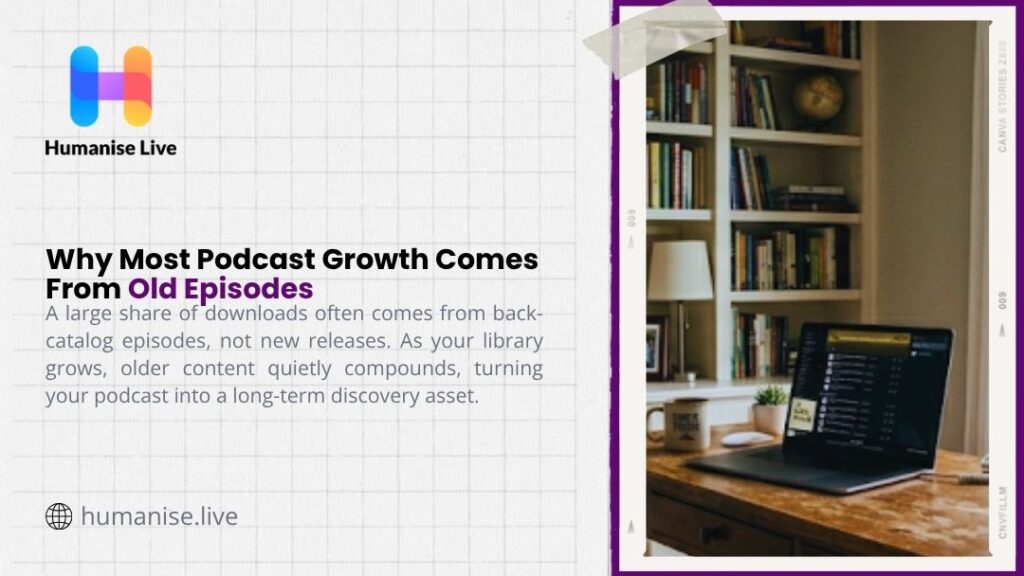
The 5 Biggest Factors That Affect Podcast Growth Speed
Growth depends on several moving parts working together. The first is clarity. If your audience doesn’t immediately understand what your podcast offers, they won’t stick around.
The second is consistency. Publishing regularly builds trust. This is where planning, using tools like structured workflows or even remote podcast recording, helps maintain rhythm. The third is content depth. Surface-level conversations rarely hold attention.
The fourth is promotion. A podcast without distribution is invisible, no matter how good it is. That’s where structured podcast marketing services can quietly accelerate growth. The fifth is format, something most creators underestimate.
Who Should Host Your Podcast? (And Why It Impacts Growth)
One question that often comes up is whether to use an internal host or bring in a professional presenter. There isn’t a single answer, but there are clear trade-offs.
| Hosting Model | Strength | Limitation |
| Internal host | Authenticity, brand voice | May need confidence-building |
| External host | Professional delivery | Less connection to the mission |
| Rotating hosts | Variety and expertise | Less consistency |
| Co-host (duo) | Natural conversation | Requires chemistry |
In most cases, an internal host builds stronger long-term growth because listeners connect with people, not polished delivery. A professional presenter can improve production quality, but it often comes at the cost of authenticity. And in podcasting, authenticity usually wins.
Many growing shows now use a co-host model. Two voices create rhythm, reduce pressure, and make conversations feel more natural. That format tends to hold attention longer, which directly impacts audience retention.
If you’re unsure, comparing internal vs external podcast host strategies can help clarify what aligns best with your brand.
Can You Make Money from a Podcast, And How Long Does It Take
Another common question tied to growth is: Can you make money from a podcast? The answer is yes, but timing matters. Most podcasts don’t generate meaningful income until they’ve built:
- A consistent listener base
- A clear niche
- Trust within their audience
According to a report by IAB (Interactive Advertising Bureau), podcast ad revenue surpassed $1.9 billion in the U.S., but most of that goes to shows with established audiences.
This means monetization typically starts around 6–12 months for small sponsorships and 12–24 months for steady income.Understanding how to make money from a podcast highlights the link between audience trust and monetization, where steady content and listener loyalty matter more than quick gains.

How to Grow Your Podcast Audience Faster (Without Burning Out)
If growth feels slow, the instinct is often to produce more content. But more content doesn’t always mean better results. Instead, focus on making each episode work harder.
Repurposing content into clips, short videos, and written assets can multiply reach. Many shows now rely on structured workflows, supported by services like podcast video editing or podcast transcription services, to extend the life of each episode.
Consistency also matters. Publishing weekly, rather than sporadically, builds listener habits. And then there’s promotion. Even great episodes need distribution. Learning how to promote your podcast effectively often makes the biggest difference between slow growth and steady traction.
A Smarter Way to Build a Podcast That Actually Grows
Instead of chasing growth, it helps to design for it from the beginning.
| Element | What It Looks Like in Practice | Impact on Growth |
| Clear positioning | Defined audience and purpose | Attracts the right listeners |
| Structured format | Consistent episode flow | Improves retention |
| Content planning | Episodes mapped in advance | Reduces inconsistency |
| Production support | Reliable editing and publishing | Maintains quality |
| Distribution strategy | Planned promotion channels | Expands reach |
When these pieces work together, growth becomes less unpredictable. It still takes time, but the path becomes clearer. This kind of approach is often what separates podcasts that plateau from those that steadily build momentum.
FAQs
How long does it take to grow a podcast on YouTube?
Growth on YouTube can take longer due to competition, but combining video content with consistent publishing can show results within 6–12 months.
How to grow your podcast on Spotify?
Consistency, strong titles, and external promotion matter most. Spotify rarely drives discovery on its own.
How fast do podcasts grow?
Most podcasts grow slowly at first, then gradually build momentum over several months.
How long does it take for a podcast to make money?
Typically 6–18 months, depending on audience size and niche.
How to build a podcast audience from scratch?
Focus on a clear niche, consistent publishing, and meaningful promotion.
Why is my podcast not growing?
Common reasons include unclear positioning, inconsistent publishing, and a lack of promotion.
How to make your podcast grow faster?
Improve content quality, repurpose episodes, and promote strategically.
Does podcast format affect growth?
Yes. A clear structure and engaging format can significantly improve listener retention.
Ready to Build Something That Actually Connects?
If your goal isn’t just to launch a podcast, but to build something people genuinely want to return to, it helps to approach it with structure and intention.
That’s where having the right support makes a difference. Explore how a more thoughtful, human-centred approach through professional podcast services can help you grow without losing what makes your message matter.
