Freelance podcast editor vs podcast agency comes down to this: freelancers suit simple, low-cost editing needs, while agencies handle full production, consistency, and growth.
This guide compares a freelance podcast editor vs podcast agency in plain terms, with a close look at cost effectiveness, edited audio quality, sound design, workflow, show notes, social media support, and long-term growth.
If you run a purpose-led brand, a B2B show, or a founder-led podcast, this article will help you choose the setup that fits your budget, your team, and the kind of show you actually want to publish.
Freelance Podcast Editor vs Podcast Agency
The question behind freelance podcast editor vs podcast agency is rarely about editing alone. Most teams ask it when the show has become bigger than a side task, the release schedule has started to wobble, or the gap between when we record an episode and the episode is ready to publish has turned into a weekly headache.
A freelance editor usually handles the post-production craft. That often means cleaned dialogue, tighter pacing, leveled sound, trimmed mistakes, and polished exports. A podcast agency, by contrast, tends to cover a much wider chain of work. That can include planning, guest coordination, branded assets, video, publishing, analytics, show notes, and clip creation for social media. So when people compare a freelance podcast editor vs podcast agency, they are really comparing specialist execution with an operating system.
That distinction matters more now than it did a few years ago. Podcasting no longer sits in an audio-only corner. Edison Research reported in 2025 that 72% of Americans aged 12+ had consumed a podcast in either audio or video format, 52% had consumed one in the last month, and YouTube was the service used most often by weekly podcast listeners at 33%. Put simply, a modern show often needs more than edited audio. It may need video assets, discovery support, and a consistent publishing rhythm to hold attention.
For a lean creator with a simple format, a freelancer can be the right call. For a brand that wants repeatable output, campaign value, and a show that feels joined-up from recording to distribution, an agency often earns its keep. And that is the real heart of freelance podcast editor vs podcast agency in 2026.
Edited Audio, Sound Design, and What a Freelance Podcast Editor Usually Handles
A skilled freelancer can do excellent work. In many cases, that is the fairest place to start. If your team already has a clear format, a dependable host, and someone in-house who can handle scheduling, publishing, and promotion, a freelance editor may be all you need.
Most freelance editors focus on the craft layer. They repair rough recordings, remove hesitations where needed, level voices, shape pacing, add music, and export files for distribution. Some will go further and prepare timestamps, basic show notes, or rough clips. Others stick strictly to post-production. That is not a flaw. It is simply the business model. A freelancer sells expertise by the episode, by the hour, or on a monthly retainer tied to a narrow scope.
This is where the freelance podcast editor vs podcast agency decision can get murky. A strong freelancer may deliver high-quality edited audio, but still leave key tasks on your side of the table. The episode might sound great, yet no one has written the episode copy, published it to the host, checked metadata, cut shorts for social media, or prepared show notes that support search visibility. In other words, the edit is done, but the episode is still not truly ready.
For teams still shaping their workflow, it helps to understand how that post-production layer fits into the wider process. Humanise Live highlights how podcast editing involves more than just basic audio cleanup, showing that podcast audio editing requires attention to detail throughout the production process when quality matters.
Podcast Production Agency, Show Notes, and the Wider Delivery Chain
A podcast production agency does not just sell editing time. It usually sells structure. That can mean a producer, an account lead, a repeatable review process, and a clear handoff from raw files to a published episode. In practical terms, that changes the day-to-day experience for the client.
When brands compare a freelance podcast editor vs podcast agency, this is often the moment the math changes. An agency is not simply more editing. It is project management, process coverage, and delivery across moving parts. One team member handles guest comms. Another checks brand consistency. Another prepares clips, show notes, titles, and platform uploads. If the show includes video, an agency can also handle frame cleanup, multicam sync, cutdowns, and platform-specific exports.
That broader support becomes especially useful for teams that want their show to do more than exist. A podcast that feeds brand authority, demand generation, or thought leadership usually needs more than a tidy waveform. It needs packaging. It needs a repeatable way to move from raw recording to public-facing content.
For brands focused on that goal, podcast production, podcast video editing, and podcast hosting services are relevant because they form part of the broader workflow that surrounds the editing process. These services highlight how different elements of the podcasting stack work together to support content creation and distribution.
In the freelance podcast editor vs podcast agency debate, agencies usually win on orchestration.
| Area | Freelance podcast editor | Podcast agency |
| Core role | Post-production specialist | Full-service production partner |
| Edited audio | Usually yes | Yes |
| Sound design | Often yes | Yes |
| Show notes | Sometimes | Usually included or available |
| Video support | Sometimes, often limited | Commonly available |
| Publishing | Sometimes extra | Usually built into the workflow |
| Social media assets | Often extra or unavailable | Commonly offered |
| Backup cover | Limited to one person | Team redundancy |
| Strategic input | Light to moderate | Moderate to extensive |
Cost Effectiveness and What You Really Pay For
Money is where the freelance podcast editor vs podcast agency gets oversimplified. On paper, the freelancer often looks cheaper. In reality, the right answer depends on what costs you are counting.
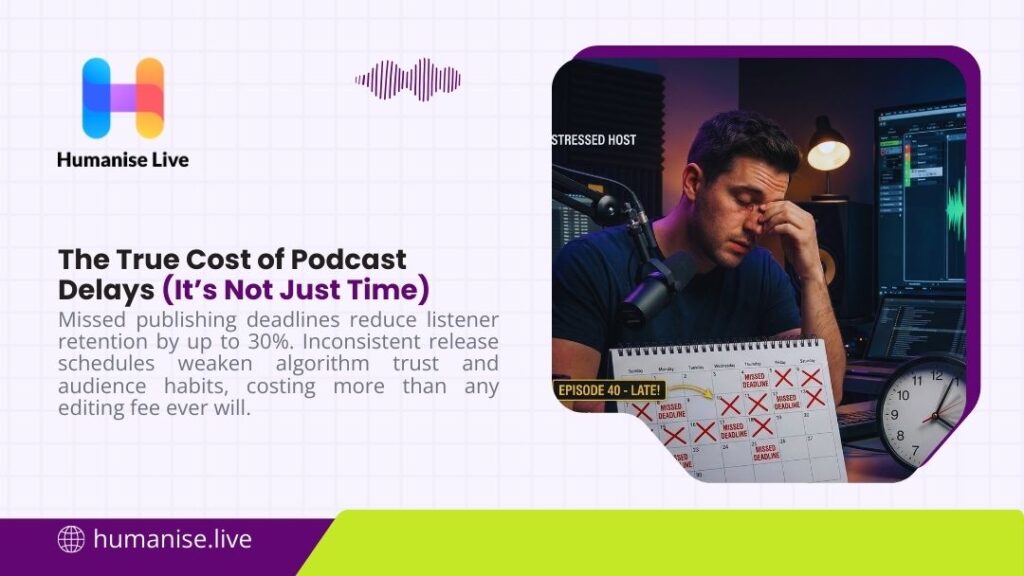
A freelancer may charge less per episode, but your internal team may still absorb guest scheduling, review rounds, publishing, copywriting, repurposing, and coordination. That hidden labor can swallow the savings. By contrast, an agency may quote more, yet remove a pile of admin and decision fatigue from your side. Cost effectiveness, then, is not only the invoice total. It is the full price of getting each episode out the door without drama.
That is why brands often underestimate the difference between line-item price and operating cost. If a marketing lead spends three hours each week chasing assets, formatting titles, fixing metadata, and briefing revisions, the cheaper option can start to look expensive.
| Cost layer | Freelancer | Agency | What usually gets missed |
| Edit fee | Lower | Higher | Buyers compare this first and stop too soon |
| Internal management time | Higher | Lower | Review rounds, chasing files, scheduling |
| Publishing and metadata | Often extra | Often included | Hidden admin hours |
| Video cutdowns | Often separate | Often packaged | Social media workload |
| Rework risk | Depends on one person | Shared across the team | Delays after illness or overload |
| Strategic guidance | Limited | Built in or available | Weak formats cost more later |
So, in the freelance podcast editor vs podcast agency comparison, the cheaper quote is not always the cheaper system.
High Quality, Editing Software, and the Standards Listeners Notice
Listeners may not know the technical terms, but they notice quality fast. They hear harsh room echo, mismatched levels, awkward pacing, clipped laughter, and intros that feel tacked on. They notice when one episode sounds crisp and the next sounds thin. They notice when a host sounds prepared in one release and scattered in the next. That is why high quality is not a vanity concern. It shapes trust.
A freelance editor can absolutely deliver that standard, especially if the brief is stable and the recordings are decent. But in the freelance podcast editor vs podcast agency decision, consistency is often the decisive factor. Agencies tend to rely on shared processes, templates, QC checks, and documented brand rules. Freelancers rely more heavily on individual memory and personal workflow. One is not morally better than the other. One is simply easier to scale.
The rise of video makes this gap wider. Data shows that podcast consumption now spans both listening and watching, which means poor visual execution can damage the overall product even when the edited audio itself is strong.
For teams that record across locations, the production chain starts before the edit. If the capture process is weak, even the best editor ends up patching holes. Remote podcast recording and podcast monitoring play a key role in maintaining consistent quality throughout the production workflow.
Social Media, Show Notes, and the Hidden Work After the Edit
An episode rarely ends at the export stage. Once the edit is done, a second layer of work begins, and that layer often decides whether the podcast actually performs or quietly disappears.
Here’s where the workload usually spreads after post-production and why this part often shapes the freelance podcast editor vs podcast agency decision more than the edit itself.
| Post-edit task | What it involves | More common with a freelancer | More common with an agency |
| Episode title and description | Writing clear, clickable copy for podcast platforms | Sometimes handled as an add-on | Often included in the workflow |
| Show notes | Creating summaries, timestamps, links, and key takeaways | Sometimes limited or brief | Usually more structured and complete |
| Transcripts | Preparing text for accessibility, reuse, and SEO support | Often outsourced or extra | Commonly available as part of the delivery |
| Social clips | Cutting short video or audio assets for promotion | May be offered separately | Often packaged into content plans |
| Platform upload | Publishing to the host, checking metadata, artwork, and scheduling | Sometimes left to the client | Frequently handled for the client |
| Asset formatting | Preparing files for YouTube, LinkedIn, Instagram, or other channels | Not always included | More often part of a wider service |
| Promotion support | Coordinating rollout across channels and campaign touchpoints | Rare unless separately scoped | More likely within a full-service setup |
The key issue is not whether these tasks exist. It is who carries them, how consistently they get done, and whether they happen well enough to give each episode a proper chance to reach people.
When a Freelancer Is the Better Choice
A freelancer makes sense when the brief is narrow, the format is stable, and the business already has enough hands on deck. If your podcast is audio-first, low-volume, and editorially simple, the right freelance editor can be a sensible, cost-aware hire. The same is true if you prefer direct communication, want tighter control, and already have someone who can handle publishing, show notes, and promotion.
In a freelance podcast editor vs podcast agency decision, freelancers often fit best when the show behaves more like a craft project than a content engine. A founder with a weekly solo format may not need a multi-person team. Nor does a hobby show, an internal leadership podcast with modest reach goals, or a pilot season that exists mainly to test appetite.
There is also a strategic reason to start small. Some brands are still working out tone, cadence, and format. In that phase, a freelancer can help them publish without locking them into a wider package too soon. For early-stage teams asking basic questions about process, learning how to start a podcast, how to make a podcast, and how to edit a podcast helps clarify whether they require a full partner or just support with editing.
When a Podcast Agency Is the Better Choice
A podcast agency becomes the stronger option when the show carries brand risk, growth targets, or executive visibility. If your company wants a polished B2B series, a founder-led interview show, a corporate thought-leadership format, or a video-led production that feeds multiple channels, an agency is usually the safer bet.
This is where freelance podcast editor vs podcast agency moves beyond preference and into business fit. A branded show often needs guest booking support, approval flows, design consistency, publishing discipline, and promotional packaging. It may also need stakeholder management, which is not trivial. Agencies are better built for that kind of environment because they can absorb complexity without dropping the work.
The wider podcast market supports that view. IAB’s U.S. Podcast Advertising Revenue Study projected the market to approach $2.6 billion by 2026, showing that podcasting continues to attract serious commercial attention. Meanwhile, Ofcom’s 2025 audio research confirmed that podcasts remain part of mainstream listening habits in the UK. When money, visibility, and brand value rise, production choices tend to shift from what is cheapest to what is dependable.
That is especially relevant for teams exploring b2b podcast production, corporate podcast production, or monetization paths such as podcast advertising. Once a show is tied to pipeline, reputation, or audience growth, the agency model often starts to make practical sense.
The Hybrid Model That Often Works Best
Here is the thing. The smartest answer to freelance podcast editor vs podcast agency is not always one or the other.
A hybrid setup can work extremely well. A company may keep strategy and approvals in-house while outsourcing edited audio, video cutdowns, and publishing support. Another team may use a freelancer for the main edit but bring in an agency for a launch season, a live event series, or a branded campaign. A third may start with an agency to build the workflow, then shift routine tasks back inside once the process settles.
This middle road works because not every show needs a full-service model all year. Sometimes the real need is operational relief around the busiest parts of production. Sometimes it is simply a better way to get more value from each episode without rebuilding the whole team.
| Scenario | Best fit | Why |
| Solo audio show with simple edit | Freelancer | Low complexity, lower spend |
| Executive interview show with video | Agency | More approvals, more assets, more risk |
| In-house team with weak post-production capacity | Hybrid | Keep strategy, outsource technical delivery |
| Short pilot season | Freelancer or hybrid | Test demand before broader commitment |
| Brand podcast tied to lead generation | Agency | Publishing discipline and campaign value matter |
Questions That Decide the Right Fit
The most useful way to judge a freelance podcast editor vs podcast agency is to ask what your team actually needs every week, not what sounds appealing in a sales call. How often will you publish? Who owns deadlines? Who briefs guests? Who writes show notes? Who checks titles, descriptions, and artwork? Who repurposes the episode for social media? Who notices if the recording quality slips? Who handles urgent fixes when someone is off sick?
Those questions reveal the real shape of the work. They also expose a common mistake: buying editing when what you really need is production. Or paying for production when what you really need is one excellent editor and a cleaner internal process.
If your team still lacks a clear release rhythm, it helps to work backwards from the publishing calendar. Understanding how to publish a podcast, how long a podcast should be, and how to promote your podcast highlights the work involved beyond recording and helps establish a consistent schedule.
Where the Smarter Choice Lands in 2026
In 2026, the freelance podcast editor vs podcast agency is no longer a narrow production question. It is a business decision about reliability, output, quality control, and how much your team can realistically carry without the show turning into a burden.
Choose a freelancer when your format is simple, your internal workflow is strong, and you need excellent edited audio more than operational support. Choose an agency when the show needs structure, consistency, high-quality delivery across channels, and enough support to turn each episode into more than a single upload. Choose a hybrid model when your team sits somewhere in the middle and wants flexibility without chaos.
What matters most is this: your podcast should not feel like a burden to maintain. It should feel like a system that works. If you’re ready to take that pressure off your team and turn your ideas into something people actually want to listen to, it might be time to work with a partner who can handle the full picture.
Start with a free episode and see how your podcast could sound when everything is done for you.
