
How long should a podcast be? The length of a podcast shapes listener retention, search performance, and how well a show holds attention across episodes. Many creators produce short daily shows of 10–20 minutes, while others rely on extended formats that reach or exceed the one-hour mark.
The typical podcast length across major industries sits close to the 40-minute range, yet shorter formats continue to attract listeners who prefer focused content. This article examines the most reliable data on episode length, the real factors behind duration choices, how different formats influence timing, and how creators can determine the best structure for their own series.
What’s the Average Podcast Length?
Industry data shows a broad but predictable range. Most episodes fall between 20 and 60 minutes. Studies of millions of published episodes indicate that the overall average is near 41 minutes, a duration shaped by global listening patterns.
Shorter shows appeal to listeners who want a quick update, while mid-length episodes support deeper conversations without becoming difficult to finish. Extended formats create room for long interviews, complex topics, or documentary-style storytelling, but only work when the content supports that scale.
The table below offers a clear view of the average duration across major episode categories.
| Category | Average Duration | Notes |
| Short-form podcasts | 10–20 minutes | Suited to news, daily insights, or quick commentary |
| Standard episodes | 20–40 minutes | Aligns with the general commute time across major cities |
| Extended standard format | 40–60 minutes | Close to the average of roughly 41 minutes |
| Long-form episodes | 60–90 minutes | Works well for interviews and deeper analysis |
| Ultra-long episodes | 90+ minutes | Common in open-ended conversational formats |
Creators who want to plan their first series can find a structured introduction in the Humanise Live How to Start a podcast guide.
Examples of Short and Long Podcasts
Well-known shows demonstrate that every duration can succeed when matched to the audience and topic. Short formats deliver clarity without excess detail, while long formats allow full exploration of ideas. The table below presents examples of both extremes.
| Podcast Name | Typical Length | Format | Notes |
| Radio Headspace | 3–5 minutes | Mindfulness | Compact reflections for daily listening |
| The Daily | 20–25 minutes | News briefing | A consistent mid-length structure that fits commute patterns |
| The Joe Rogan Experience | 1–3 hours | Long-form conversation | Open, free-flow interviews with high listener loyalty |
| Dan Carlin’s Hardcore History | 3–6 hours | Narrative history | Ultra-long episodes built on deep research |
These examples highlight that duration succeeds when supported by structure, clarity, and a loyal audience rather than a rigid industry rule.
Pros and Cons of Short Podcasts
Short podcasts offer speed and consistency but may limit the depth of each episode. The table outlines the main benefits and drawbacks.
| Aspect | Pros | Cons |
| Listener experience | Easy to finish; less commitment | Limited space for detailed topics |
| Production | Reduced editing and faster release cycles | Harder to include interviews or narrative flow |
| Scheduling | Supports daily or multi-weekly publishing | Requires frequent idea generation |
| Engagement | Strong for busy listeners | Fewer opportunities for rich storytelling |
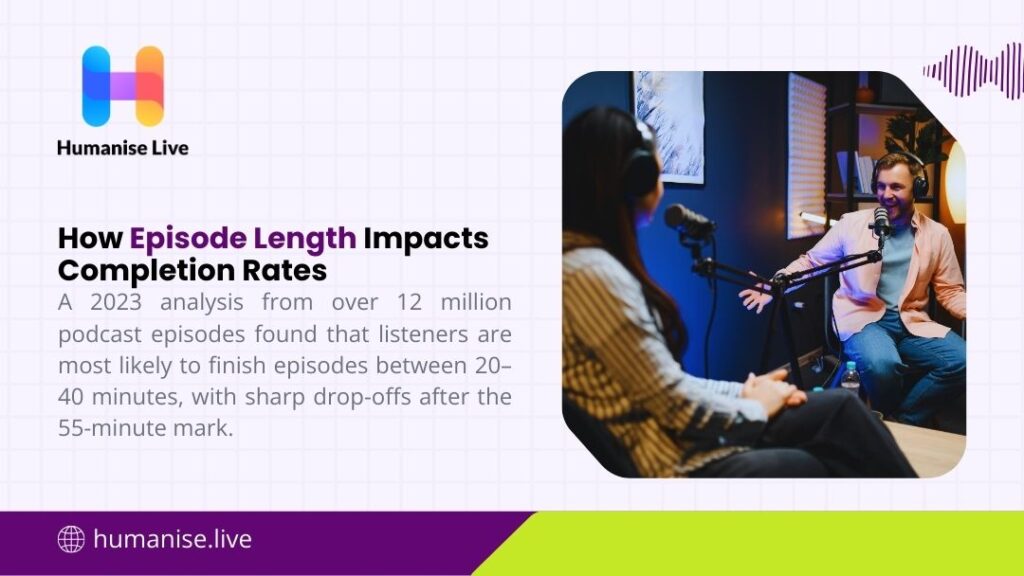
Pros and Cons of Long Podcasts
Long podcasts allow deeper conversation and broader storytelling, but require more production time. The table summarises the main advantages and limitations.
| Aspect | Pros | Cons |
| Listener experience | Space for full interviews and detailed insights | Higher risk of drop-off if pacing slows |
| Production | Works well for complex topics | Longer episodes require more editing time |
| Discovery | Appeals to niche or loyal audiences | New listeners may hesitate due to the length |
| Engagement | Extended conversations feel natural and immersive | Consistency becomes more difficult to maintain |
Why Podcast Length Matters – How Long Should a Podcast Be?
Podcast length matters because it sets the pace of your show, shapes how your audience experiences each episode, and influences the overall identity of your brand. A clear duration gives listeners a sense of structure.
When a series maintains a predictable length, listeners form habits around it, whether during a commute, a gym session, or a daily break. Patterns like these increase repeat listening and improve completion rates, which are important signals across podcast platforms.
Length also affects the depth you can deliver. Short podcasts work well when the goal is to share a single idea, recap news, or answer focused questions. Longer episodes allow for full conversations, multiple viewpoints, and story arcs that take time to unfold. Duration becomes a tool to serve your message rather than a fixed rule.
Production teams feel the impact of length as well. A consistent duration simplifies scripting, scheduling, remote recording, guest management, and editing. When every episode fits a clear model, the entire routine becomes predictable.
This reduces the pressure that often leads to skipped releases or burnout, a common issue across new shows. When your production process works smoothly, your audience benefits from a reliable publishing rhythm.
For brands, length also supports positioning. A short daily podcast reflects agility and constant relevance, while longer formats suggest depth, leadership, and a more conversational relationship with the audience. Podcast length is not just a number; it’s a strategic choice that influences perception, retention, and growth.
Factors That Influence Podcast Length
Several core elements shape how long a podcast episode should be. Duration choices depend on the needs of the audience, the nature of the topic, and the reliability of the production setup. The table below presents the main factors that guide length decisions.
| Factor | Role in Duration |
| Listener habits | Episodes often follow commute patterns, gym sessions, or work breaks |
| Format choice | Solo shows lean shorter; interview and narrative shows lean longer |
| Topic depth | Detailed subjects require extended time for clarity |
| Release schedule | Daily shows favour short episodes; weekly shows support mid-length or long episodes |
| Production workflow | Editing time and team capacity affect practical duration limits |
Many branded and B2B shows rely on consistent duration to support structured output. A complete overview of this workflow appears on the Humanise Live podcast production page.

How Different Podcast Formats Affect Duration
Different podcast formats shape length in predictable ways. Solo commentary often moves quickly, while co-hosted conversations expand naturally. Interviews require more time to develop ideas, and narrative or documentary formats follow longer arcs. The table below summarises these patterns.
| Format | Typical Length |
| Solo commentary | 10–25 minutes |
| Co-hosted discussion | 25–45 minutes |
| Guest interviews | 45–90 minutes |
| Documentary or history | 60–120 minutes |
| B2B or corporate episodes | 20–35 minutes |
Creators who work with guest-driven episodes can refine pacing through the Humanise Live podcast audio editing service, while shows recorded remotely can maintain stable timing with the support of remote podcast recording.
Tips for Choosing Your Ideal Podcast Length
Choosing the ideal length starts with defining what your show aims to achieve. A podcast built around industry updates or personal commentary works best with focused, shorter episodes. A show that depends on expert interviews or narrative storytelling needs more time to develop ideas. The purpose of each episode should guide its duration.
Audience expectations play a central role. Some listeners prefer short, concentrated episodes that fit naturally into their daily routines. Others seek long, unfiltered conversations that offer a deeper look into a topic. Understanding when and how your audience listens can help narrow the target length that feels natural for them.
Your release schedule affects your ideal length as well. Daily or twice-weekly publishing works better with short formats because the time required to script, record, and edit expands rapidly as episodes get longer. Weekly or bi-weekly schedules allow more space for extended episodes without overloading the production routine.
Clarity of message is another factor. If an episode can deliver its point in fifteen minutes, stretching it to forty weakens engagement. If your content requires fifty minutes to unfold, compressing it into 20 may leave the audience unsatisfied. The strongest episodes stay true to the needs of the topic.
Before locking in a specific length, creators often start by defining a range rather than a fixed number. For example, a show may target twenty to 35 minutes, giving the freedom to adjust based on the depth of each guest or discussion. Listener feedback and early analytics help refine this range until it becomes the signature length of your series.
Tips for Optimizing Your Episode Length
Optimizing episode length occurs after recording and focuses on refining flow, pacing, and clarity. This process helps you maintain the target duration without compromising the value of the conversation.
Many creators begin by reviewing the raw recording to identify where the pace slows, where ideas repeat, or where tangents pull the episode away from its main point. Removing these sections tightens the episode and preserves listener engagement.
Transitions between topics also play a role. Smooth shifts help maintain momentum and make the podcast feel more intentional. When transitions become long or disconnected, the episode starts to feel heavier than necessary. Clean transitions help shorten episodes without cutting meaningful content.
Guest interviews often produce longer recordings than expected. Instead of pushing everything into one extended episode, splitting the conversation into two parts can protect pacing and help maintain strong retention. This approach works especially well when the guest covers multiple themes or stories, each of which can stand alone as a focused episode.
Analytics reveal whether length supports or harms engagement. Completion data, drop-off points, and listener notes help you identify where your audience loses interest. When patterns appear, you can adjust future episodes to stay closer to the length that listeners actually enjoy. This feedback loop strengthens your show over time.
Creators who work with remote recordings or multi-voice formats often refine length through professional editing. Techniques such as removing filler words, tightening pauses, balancing pacing across speakers, and shaping the flow of discussion help maintain a polished sound that respects your chosen duration. If an episode feels strong, moves with purpose, and respects the listener’s time, the length will naturally support your growth.
Key Takeaways
| Key Point | Insight |
| Core duration range | Most episodes fall between twenty and forty-five minutes |
| Short vs long | Short episodes offer quick value; long episodes support deeper ideas |
| Listener patterns | Audience routines shape preferred episode length |
| Format influence | Interviews, narrative shows, and deep-dive formats lean longer |
| Growth factor | Consistent length improves loyalty and long-term performance |
A Clear Path Forward
The length of a podcast sets the rhythm of a series, shapes listener expectations, and guides the pace of production. When duration supports the structure of the show, listeners stay connected across episodes.
For creators who want stable timing, clear workflows, and strong audio quality, the Humanise Live podcast hosting service outlines a complete approach to scheduling and distribution. If you want expert support from planning to publication, you can connect with the Humanise Live team through the main website and develop a series built around your goals and your voice.
