
Podcasts now play a direct role in how brands get discovered online. They don’t just support search rankings; they shape how content appears in AI-driven results as well.
They allow organisations to turn real conversations into searchable, meaningful content that builds trust over time, not just traffic.
This article explains how podcasts strengthen both SEO and GEO, while showing how purpose-driven brands can use them to grow visibility in a more human, sustainable way.
How do podcasts help with SEO and GEO?
Podcasts don’t rank in isolation. They work as part of a wider content system. Each episode creates layers, audio, text, metadata, and supporting pages that search engines can interpret.
When a business publishes an episode alongside clear episode titles, detailed show notes, and accurate transcriptions, it creates something closer to a structured knowledge base than a single piece of content. That structure matters.
Search engines rely on context. AI systems rely on clarity. Podcasts, when handled properly, provide both. Conversations tend to include natural phrasing, real questions, and topic depth. That combination increases relevance for long-tail queries. And that’s how podcasts help with SEO and GEO.
They widen the surface area of your content. They introduce new keyword variations without forcing them. They give search engines more signals to work with. For organizations focused on purpose, this approach also allows stories to remain human while still being discoverable.
Why does podcast SEO matter more in 2026?
Search behaviour has shifted in a way that’s hard to ignore. Users don’t just read anymore. They listen, watch, and interact across multiple formats. Search engines have adapted to reflect that behaviour. Audio content is no longer treated as secondary.
According to The Infinite Dial 2024 report by Edison Research, 47% of the U.S. population aged 12+ listened to a podcast in the last month, with listening continuing to grow year over year. But here’s the part that matters more. Those listeners aren’t just consuming content, they’re spending time with it. And time is one of the strongest signals search engines track.
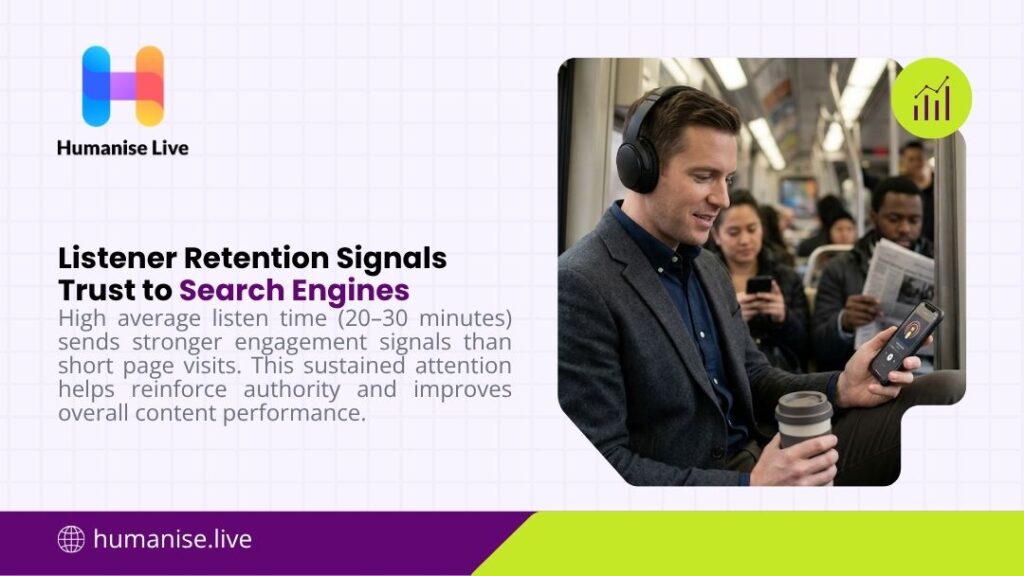
That matters for two reasons. First, longer engagement signals often correlate with trust. A listener who stays for 25 minutes sends a stronger signal than someone who scans a blog post for 30 seconds.
Second, search engines now interpret content ecosystems rather than isolated pages. A podcast supported by blog posts, transcripts, and internal linking creates a network that reinforces authority.
According to Google’s E-E-A-T framework, content is based on experience, expertise, authoritativeness, and trustworthiness. That shift explains why podcast SEO is no longer optional for brands that want consistent visibility. A well-produced podcast, especially one built around real expertise, naturally demonstrates experience in a way that short-form content often can’t.
How podcasts improve search rankings (SEO impact)
Search engines reward consistency, depth, and topical authority. Podcasts contribute to all three. When each episode targets a specific topic and includes keyword-rich descriptions, it creates multiple indexed assets. Over time, this builds a strong topical cluster.
| SEO Element | Podcast Contribution |
| Keyword coverage | Each episode targets unique search queries |
| Content depth | Long-form discussions increase relevance |
| Backlink potential | Guests often share and link back |
| Engagement signals | Longer listening sessions improve dwell time |
| Internal linking | Episode pages connect to related resources |
When structured properly, this turns your podcast into an evolving content library rather than a series of isolated episodes.
For example, integrating podcast content with a well-structured podcast production service allows search engines to connect themes and strengthen authority. Transcriptions also play a central role. A podcast transcription service ensures every spoken word becomes indexable text.
How podcasts influence GEO (AI search visibility)
Generative Engine Optimization focuses on how content appears in AI-generated responses. Unlike traditional SEO, GEO relies heavily on contextual relevance, natural language, and authority signals. Podcasts naturally deliver these elements.
Conversations often include real questions, detailed explanations, and expert opinions. When transcribed and published, this content becomes accessible to AI systems that generate answers.
This increases the likelihood that your brand appears in AI summaries, voice search responses, and conversational search results. In simple terms, podcasts feed the systems that shape modern search experiences.
Podcast SEO best practices that actually work
Effective seo for podcasts depends on structure rather than volume. Each episode should include clear titles, descriptive summaries, and properly formatted show notes. These elements help search engines understand the context.
| Element | Purpose |
| Episode titles | Capture search intent |
| Show notes | Provide context and internal links |
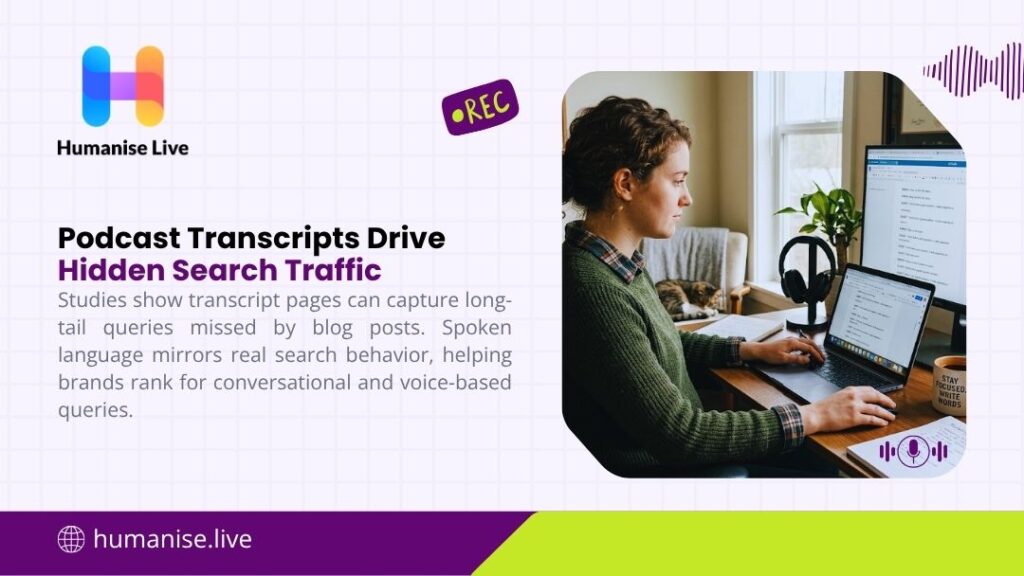
| Transcriptions | Enable indexing |
| Audio quality | Improve listener retention |
| Distribution | Expand reach across platforms |
Using reliable podcast hosting services ensures proper distribution across major platforms. Promotion also plays a role. A strategic approach through podcast marketing services helps increase visibility and engagement.
Podcast formats and hosting strategy (what actually works)
A question often comes up during planning: who should host the podcast? Some organizations consider hiring a professional presenter. It sounds appealing at first. A trained voice, polished delivery, and fewer internal demands. But here’s the issue. External hosts rarely carry the same depth of understanding about your mission.
An internal host, even without media training, brings authenticity. They know the subject, the audience, and the purpose behind the content. The idea of who should host a podcast often comes down to familiarity and credibility; someone already close to the topic can deliver more natural and engaging conversations compared to an external voice.
What tends to work well is consistency. A single host builds familiarity. A dual-host format often performs even better, as it introduces natural conversation and balance. Listeners stay engaged because the dialogue feels real.
Rotating hosts can introduce variety, though it may weaken continuity if not managed carefully. External presenters still have a place, particularly for large-scale productions. Yet for most purpose-driven organizations, an internal voice tends to resonate more strongly.
Podcast SEO vs traditional content
Podcasts and written content serve different roles, though they often work best together.
| Factor | Blog Content | Podcast Content |
| Engagement | Moderate | High |
| Longevity | Medium | Long-term |
| Repurposing | Limited | Extensive |
| SEO impact | Direct | Indirect but cumulative |
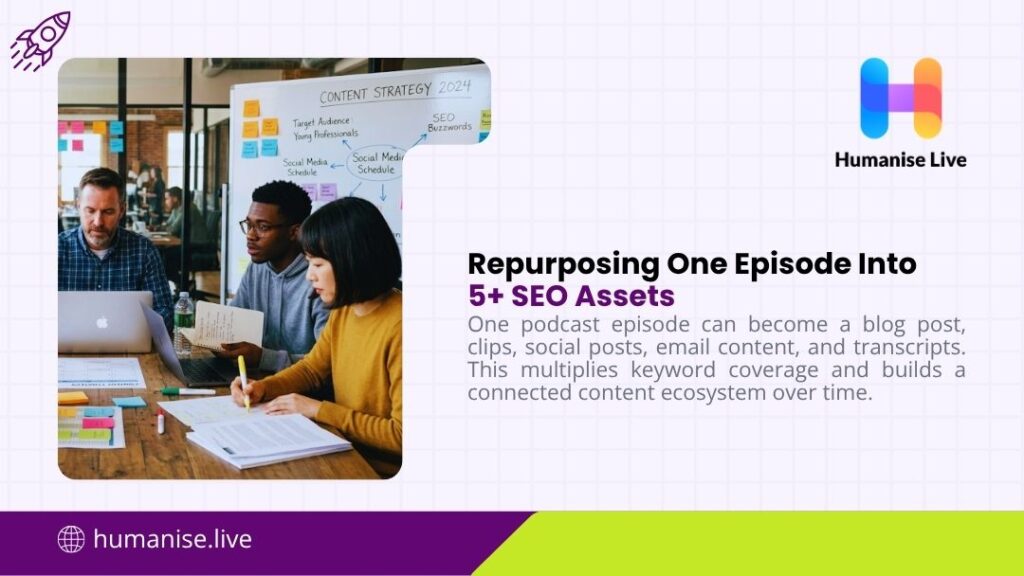
A single podcast episode can generate multiple content pieces. With proper planning, this includes blog posts, social content, and video snippets. Tools like remote podcast recording make it easier to produce content even when teams are distributed.
Common mistakes that limit podcast SEO
Some patterns appear repeatedly when podcasts fail to perform. The issues are rarely technical. They tend to come from how content is structured and maintained.
| Mistake | What Happens | Impact |
| No keyword research | Topics miss search intent | Low visibility |
| Weak show notes | Lack of context | Poor indexing |
| No transcription | Audio remains invisible | Missed rankings |
| Irregular publishing | Inconsistent signals | Reduced trust |
| No internal linking | Isolated content | Weak authority |
Fixing these issues doesn’t require complex changes. It requires consistency. Addressing these gaps often connects with the same factors behind why my podcast is not growing, where irregular publishing, unclear positioning, or weak audience engagement can limit overall growth.
Real workflow: Turning podcast content into SEO assets
Podcasting works best when treated as part of a wider content system.
| Stage | Output |
| Recording | Raw episode |
| Editing | Polished audio or video |
| Transcription | Searchable text |
| Publishing | Blog and show notes |
| Promotion | Social and distribution |
Maintaining quality at each stage matters. Services like podcast editing and podcast video editing ensure the final output meets professional standards.
Does having a podcast help with SEO and GEO long-term?
Yes, though results take time. Podcasts build authority gradually. Each episode contributes new keywords, strengthens topical relevance, and increases engagement.
Unlike short-form content, podcast episodes remain relevant for longer periods. They continue to attract listeners and search traffic well after publication. For beginners, understanding how to start a podcast provides a strong foundation, covering the essential steps needed to launch and grow consistently.
FAQs
What are the 4 types of SEO?
The four main types include on-page SEO, off-page SEO, technical SEO, and local SEO. Each focuses on a different aspect of improving search visibility.
What are the 4 pillars of SEO?
The core pillars are content, technical structure, authority (backlinks), and user experience. All four work together to influence rankings.
What is the golden rule of SEO?
The golden rule is simple: create content that answers user intent clearly while maintaining relevance and quality.
Which is better, SEO or GEO?
They serve different purposes. SEO helps content rank in search engines, while GEO focuses on being selected in AI-generated responses. Both are now essential.
Can I do SEO optimization myself?
Yes, but it requires time and consistency. Many businesses start independently before moving to structured systems or external support.
How do podcasts help with SEO and GEO?
They expand content reach, introduce natural keyword variations, and provide structured data that both search engines and AI systems can interpret.
Do podcast transcripts really improve SEO?
Yes. Transcripts allow search engines to index audio content, making episodes discoverable through text-based queries.
How long does it take for podcast SEO to work?
Results vary, but consistent publishing over several months usually leads to noticeable improvements in visibility.
Where this leads for brands in 2026
Search visibility no longer depends on a single channel. It comes from a connected system where content supports itself across formats. Podcasts play a central role in that system. They bring depth, authenticity, and consistency, all of which search engines and AI platforms value.
For organizations that want to build long-term authority, investing in structured podcast content is no longer optional. Working with a team that understands both storytelling and search, such as Humanise Live, can help turn each episode into a measurable asset. Because in the end, content only matters when it gets discovered.
