
Podcast production costs UK businesses face in 2026 depend on far more than just microphones and studio hire. The real budget comes down to the spirit of production quality, audio and video needs, audience expectations, and how much time professionals spend actually shaping the final product. This guide breaks down real UK pricing so you can plan with total clarity, not just guesswork.
If you want a tailored quote based on your format, frequency, and whether you need video, you can get in contact with Humanise Live and map the fastest route to quality without wasting budget.
Podcast production costs UK: How much it really is in 2026
Podcast production costs UK creators encounter range widely because “producing a podcast” can mean entirely different things to different people. A solo founder recording at home will see one price. A brand recording a professional podcast with video, editing, and marketing support will see another.
In the UK market, the cost to produce a podcast typically falls into four tiers. Entry-level editing services start around £100 per episode, while fully managed agency production can exceed £3,000 per episode. According to UK studio pricing data, professional audio and video production accounts for most of the spend because it includes technical staff, post-production, and content preparation.
The table below reflects current UK pricing averages across agencies, studios, and independent producers.
| Production level | Typical UK cost per episode | What’s usually included |
| Basic audio editing (freelancer) | £100–£300 | Clean-up, levelling, export |
| Professional audio | £350–£800 | Editing, sound design, show notes |
| Audio and video | £800–£1,500 | Multi-camera recording, video edits |
| Economical full-service partner (lean provider) | £200–£600 | End-to-end production without large-agency overhead, often priced per episode |
| Full agency service | £1,000–£3,500+ | Strategy, recording, editing, distribution |
Not all podcast production companies operate on high monthly retainers; some lean providers deliver full-service podcast production at per-episode rates that sit much closer to independent pricing. For anyone starting a podcast, these figures explain why podcast production costs UK brands quote can differ so sharply from freelancer estimates.
Humanise Live is typically more economical than traditional agency pricing because it publishes per-episode rates rather than high retainers (basic editing + distribution from £200/episode, full service from £300/episode), and it offers the first episode free so teams can test quality, workflow, and communication before committing.
What affects the cost to produce a podcast in the UK
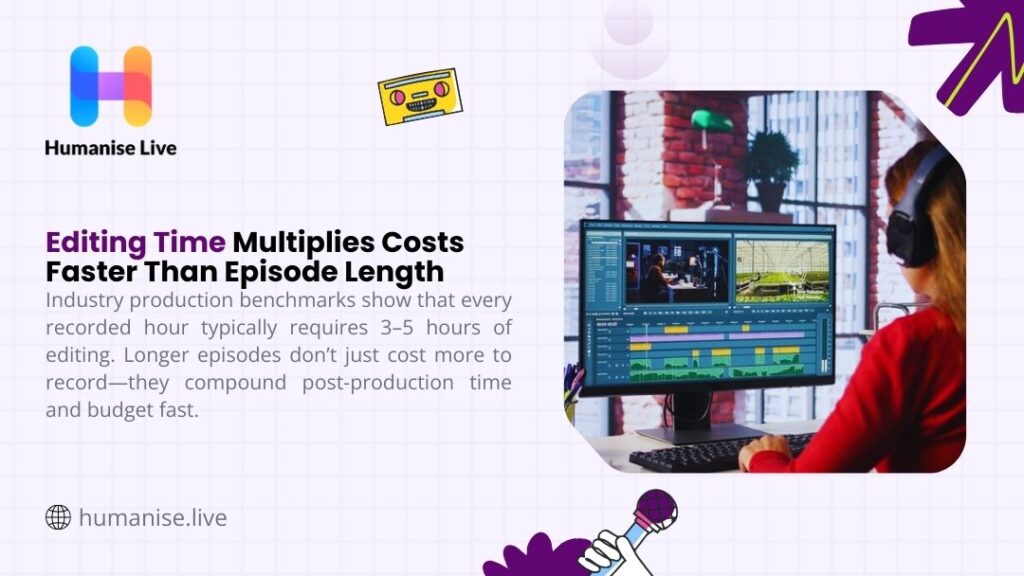
The cost varies because production is labour-driven. Equipment matters, but human time matters more. Editing one hour of high-quality audio can take three to five hours, according to the audio production guidance.
Sound quality expectations also influence price. Corporate and B2B podcasts demand broadcast-level polish, which pushes editing time and quality control higher. Add video recording, and costs rise again. Cameras, lighting, framing, and synchronized editing introduce complexity that audio-only podcasts avoid.
The target audience plays a role too. Podcasts aimed at senior decision-makers or investors must sound credible and consistent. That often means working with a professional podcast studio or agency rather than recording ad hoc.
Marketing teams can also drive up the cost to produce a podcast when they require transcripts, social media clips, or analytics. Many organizations offset this by working with a partner that handles podcast production end to end, rather than stitching together multiple suppliers.
This is why brands researching podcast production often start by reviewing a professional podcast production service rather than hiring piecemeal support.
Studio hire and recording prices across the UK
Studio recording remains common for video podcasts and panel shows, especially in major cities. Podcast production costs in UK studios depend heavily on location and technical support.
Central London commands the highest rates, driven by real estate and staffing costs. Regional studios offer more affordable options, while remote podcast recording eliminates the need for studio hire altogether.
| Location | Typical hourly studio rate | What’s typically included |
| Central London | £100–£200+ | Studio space, professional mic setup (engineer or technical support often included at this level) |
| Manchester | £60–£108+ | Audio/video rooms with mic kits (engineer often optional) |
| Leeds | £40–£120+ | Podcast/recording rooms with varying equipment levels |
| Remote recording | £0+ | Online capture (no studio space) |
In practice, once you account for staffed setups, reliable equipment, and sessions that don’t lose time to technical troubleshooting, Central London studio bookings almost always start at £100/hour and climb quickly depending on crew and camera requirements.
This shift is why many UK brands now prioritize remote or hybrid podcast production services, reducing studio time while keeping professional quality intact.
Why editing and post-production shape most of the budget
Editing determines whether a podcast sounds amateur or professional. Podcast production costs UK agencies often quote, allocating over half the budget to post-production alone.
Audio editing covers noise removal, levelling, pacing, and consistency. Video editing adds colour correction, multi-camera switching, captions, and platform formatting. This explains why organizations that invest in podcast video editing see higher returns despite higher upfront costs. Editing also enables repurposing, which stretches the value of each episode across platforms.
For teams handling audio internally, learning how podcast audio editing works can help reduce costs, though it increases internal workload.
Outsourcing versus DIY podcast production in 2026
Choosing between outsourcing and DIY podcast production in 2026 is no longer about talent alone. It’s about time, consistency, risk tolerance, and how visible the podcast needs to be. Tools have improved, yes, but expectations have risen even faster. Listeners now compare independent shows to broadcaster-level output without thinking twice.
DIY podcast production still appeals to early-stage creators and small teams who want control and minimal cash outlay. Outsourcing, on the other hand, appeals to organizations that see podcasting as a long-term channel rather than a side experiment. The difference becomes clear once you look beyond surface costs and consider hidden time investment, output reliability, and audience perception.
| Area of comparison | DIY podcast production | Outsourced podcast production |
| Upfront financial cost | Lower cash spend, higher time cost | Higher cash spend, predictable budgeting |
| Time commitment | High: recording, editing, fixes, publishing | Low; production handled externally |
| Consistency of output | Often irregular due to workload | Structured release schedules |
| Technical risk | Higher; issues solved reactively | Lower; handled by specialists |
| Sound and video quality | Depends on skill level | Professionally controlled |
| Scalability | Difficult beyond a few episodes | Designed for growth |
| Audience perception | Can feel informal or uneven | Signals credibility and trust |
Outsourcing often saves money indirectly by saving time: fewer do-overs, fewer missed releases, and far fewer internal hours spent fixing audio or managing logistics. That reclaimed time is usually where the real cost savings appear.
That’s the main reason teams outsource: it saves time, prevents rework, and often lowers total cost once you factor in internal hours, so if you want to pressure-test your budget, speak to the Humanise Live team about what you actually need versus what you can skip.
A realistic UK podcast budget example
To put podcast production costs UK teams face into context, consider a 12-episode professional podcast with audio and light video support.
| Cost category | Estimated total |
| Recording (studio or remote) | £2,400 approx. £200/ep |
| Editing and post-production | £4,800 approx. £400/ep |
| Video clips and assets | £1,800 approx. £150/ep |
| Hosting and distribution | £240 |
| Transcription and monitoring | £600 approx. £50/ep |
| Total | £9,840 |
Teams looking to reduce this often prioritize remote recording, shorter episode length, and batch production. Those learning how to start a podcast usually underestimate editing time, which is why budgets often drift upward after launch.
Quality, audience trust, and why it affects cost
Quality doesn’t just affect how a podcast sounds. It shapes whether listeners stay, return, and recommend. In a saturated podcast market, trust forms quickly and breaks even faster. Poor audio, inconsistent volume, or awkward pacing signal a lack of care, even when the ideas themselves are solid.
Audience trust is cumulative. Each episode either reinforces credibility or erodes it. This is why higher production costs often correlate with better long-term performance rather than short-term spikes. A polished podcast creates a sense of reliability, which matters most for B2B shows, branded series, and thought-leadership content.
There’s also a psychological layer at play. When listeners hear clean sound quality and balanced production, they assume competence elsewhere. That assumption carries over into brand perception, expertise, and authority. In marketing-led podcasts, this effect often outweighs the actual content length or guest profile.
In shows built around real people, lived experience, or social impact, production quality quietly protects the speaker as much as the listener. Clear audio gives weight to the voice behind the message.
Cost enters the picture because trust takes labour. Skilled editing, quality control, and production oversight are human tasks, not automated steps. Cutting those corners lowers immediate spend but increases churn risk. That’s why many teams reassess podcast production costs UK agencies quote and realize they’re paying less for equipment and more for judgment.
FAQs about podcast production cost
Do you have to pay to start a podcast?
Actually, you don’t strictly have to pay, but professional standards almost always carry a price tag. You could technically record using free tools, but those costs creep in quickly the moment you want a crisp sound, a consistent release schedule, or a platform to host it. Most creators find themselves investing in a half-decent mic or basic editing help within the first month.
How much does it cost to have a podcast on YouTube?
The price of putting your show on YouTube really comes down to whether you’re just uploading an audio file with a static image or a full-blown video production. Audio-only is cheap. Full video, however, is a different beast; expect to pay more for lighting, multi-cam setups, and the extra editing hours. Basic video production for podcasts in the UK usually starts at £300 per episode.
Is podcast hosting free in the UK?
You’ll find free tiers on some hosts, but they almost always come with catches, like storage caps or limited data. If you’re serious, paid plans in the UK usually sit between £5 and £25 a month. Paying upfront gives you much better control over your RSS feed and helps you avoid a massive headache if you ever need to migrate your show later.
Why do podcast production costs vary so much?
It’s basically down to time. It’s a labour-based service. The length of the episode, the depth of the sound design, whether you need video, and how often you publish all pull the lever on the final price. A simple chat recorded on Zoom is a world away from a narrative-driven branded series with custom music.
Can a podcast make money without high production costs?
Yes, it’s possible, though usually a lot slower. While monetization relies on having an engaged audience, higher production quality acts as a shortcut. It signals to potential sponsors or high-level guests that you’re a professional worth their time, which often leads to revenue opportunities much earlier in the game.
What this means for serious podcasting in 2026
Podcast production costs UK organizations face aren’t just pulled out of thin air. They represent the expertise and the sheer man-hours needed to meet modern audience standards. You can certainly find “cheap” options, but in a world of high-quality content, they rarely cut through the noise.
If your goal is a show that sounds authoritative and actually grows over time, you have to be realistic about the budget. Whether you build a team internally or partner with an agency, knowing exactly where your money is going is the only way to avoid nasty surprises.
If you are currently mapping out a new show, take a breath and look at the strategy first. Who is listening? How often will you publish? What level of quality represents your brand? Once those questions are answered, the right budget usually reveals itself. If you need clarity before you commit, sit down with a production partner who treats this as a long-term investment. Proper planning now, using real human judgement, is what saves you from wasted effort and lost trust six months down the line.
