
Outsourcing podcast production pros and cons matter more now than at any point in podcast history. With over five million podcasts listed globally and production standards rising fast, creators face a clear choice: manage everything internally or rely on external specialists.
This article examines the pros and cons of outsourcing podcast production with a realistic lens, grounded in workflow realities, quality expectations, and business outcomes rather than hype.
Outsourcing Podcast Production Pros and Cons: What Actually Changes When You Hand It Off
Outsourcing podcast production pros and cons sound straightforward on paper. In practice, they surface slowly, usually after the third or fourth missed deadline, or the moment an episode goes live, sounding nothing like it did in your headphones.
At first, most podcasts feel manageable. A microphone, a quiet room, a bit of trimming. Then reality creeps in. Editing stretches longer than expected. Publishing slips to “tomorrow.” Audio quality varies depending on who spoke louder or farther from the mic. Listeners don’t complain, but they stop coming back. That’s the point where outsourcing enters the conversation.
The upside of outsourcing podcast production often shows up as relief. The downside tends to arrive as hesitation. Cost feels visible. Control feels abstract. Both deserve attention. The real question isn’t whether outsourcing podcast production has pros and cons. It’s whether the trade-offs match how serious the podcast is meant to be.
What Podcast Outsourcing Really Covers
Podcast outsourcing is rarely just about editing. That’s the shorthand version, and it misses most of the work.
In real-world terms, outsourced podcast production covers everything that happens once the conversation ends. Sometimes even before it begins. External teams often help shape episode flow, flag recording risks, and standardize technical setups, especially when guests join remotely. That alone prevents hours of cleanup later.
After recording, the invisible labor starts. Audio gets balanced so voices don’t jump between sentences. Pauses tighten without sounding rushed. Background noise disappears. Music is placed with intention rather than habit. These decisions are small, but they accumulate. They determine whether a listener stays through the midpoint or quietly taps away.
Beyond sound, outsourcing usually includes packaging. Show notes need clarity, not fluff. Episode files must meet platform requirements. Publishing schedules matter more than most creators admit. A missed release trains listeners to forget you. Outsourced production teams exist to prevent that drift.
The key distinction is this: outsourcing does not replace your voice. It replaces the systems that protect it.
Why Many Creators Choose Outsourcing
Most creators don’t outsource because they can’t produce a podcast. They outsource because they can’t keep producing one without sacrificing something else.
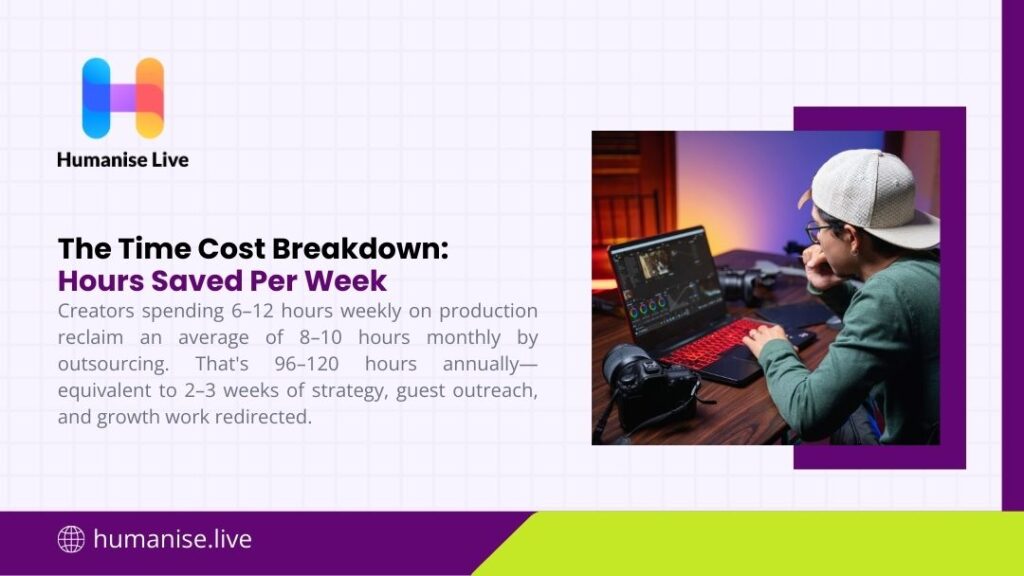
Time is the obvious pressure. Editing a single episode can consume an evening. Writing show notes eats another hour. Publishing, tagging, checking levels, monitoring playback issues, each task feels small until they pile up. Weeks pass. Momentum slows.
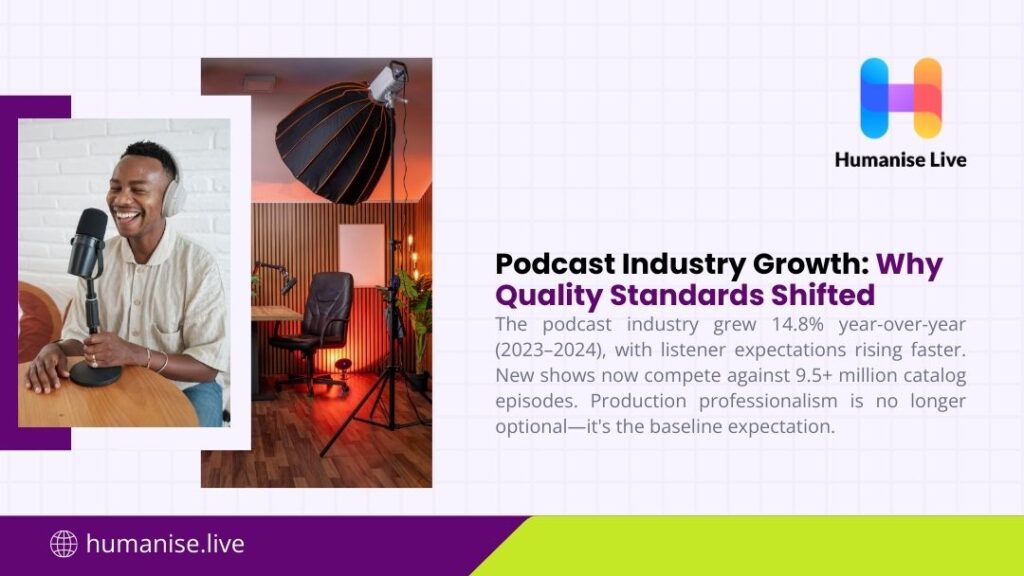
Quality is the quieter factor. Listeners expect a high-quality podcast even if they never say so out loud. They notice uneven sound. They notice awkward pacing. Professional podcast production reduces those friction points through repetition and experience, not shortcuts. Here’s how creators typically experience the difference over time:
| Creator focus | Handling production alone | Outsourcing production |
| Weekly workload | Heavy and unpredictable | Stable and contained |
| Audio results | Inconsistent | Reliable |
| Release timing | Often delayed | Predictable |
| Mental energy | Split | Directed toward content |
| Long-term output | Fragile | Sustainable |
Before outsourcing, podcasting competes with everything else. After outsourcing, it gets its own lane.
When outsourcing fits best
Outsourcing fits best once a podcast carries expectations beyond personal enjoyment. That might be a brand reputation, a cause-driven mission, or a business goal that depends on consistency.
For founders and marketers, production work competes with strategy. For charities and NGOs, credibility matters. Poor audio undercuts trust, even when the message is strong. For B2B podcasts, irregular releases weaken authority faster than weak promotion ever will.
Remote podcast recording also changes the equation. Managing guests across time zones introduces technical risk. Outsourced teams anticipate those issues. They build buffers. They plan for failure before it happens.
Outsourcing is less useful for creators who want to learn production itself. It works best for those who want podcasting to serve a purpose rather than become one.
Outsourced vs In-House Production Comparison
Comparing outsourced and in-house production isn’t just about money. It’s about where friction lives.
| Dimension | Outsourced production | In-house production |
| Workflow | Structured and repeatable | Reactive |
| Skill depth | Specialist-driven | Self-taught |
| Scalability | Built-in | Limited |
| Error recovery | Fast | Slow |
| Consistency | High | Variable |
In-house systems strain as episode volume increases. Outsourced systems assume growth from the start.
The drawbacks worth acknowledging
Outsourcing podcast production introduces real compromises. Cost remains the most immediate. Professional labor replaces software subscriptions, and that shift can feel abrupt.
There’s also a loss of immediacy. Editing your own episode means instant changes. Outsourcing requires communication, revisions, and patience. Early misalignment can frustrate creators who expect mind-reading rather than collaboration.
Dependency is another concern. Once production moves external, continuity depends on agreements and people. Switching partners later involves onboarding time. Some creators also feel disconnected from the technical side, which can reduce confidence during live issues or platform changes.
These drawbacks don’t disappear. They simply become manageable when roles are clear.
Is outsourcing good or bad for podcast growth?
The question: Do you think outsourcing is good or bad? misses nuance. Outsourcing podcast production pros and cons exist because podcasting serves different goals. For casual creators, in-house control may feel rewarding. For brands, charities, and B2B teams, outsourcing aligns better with scale and reliability.
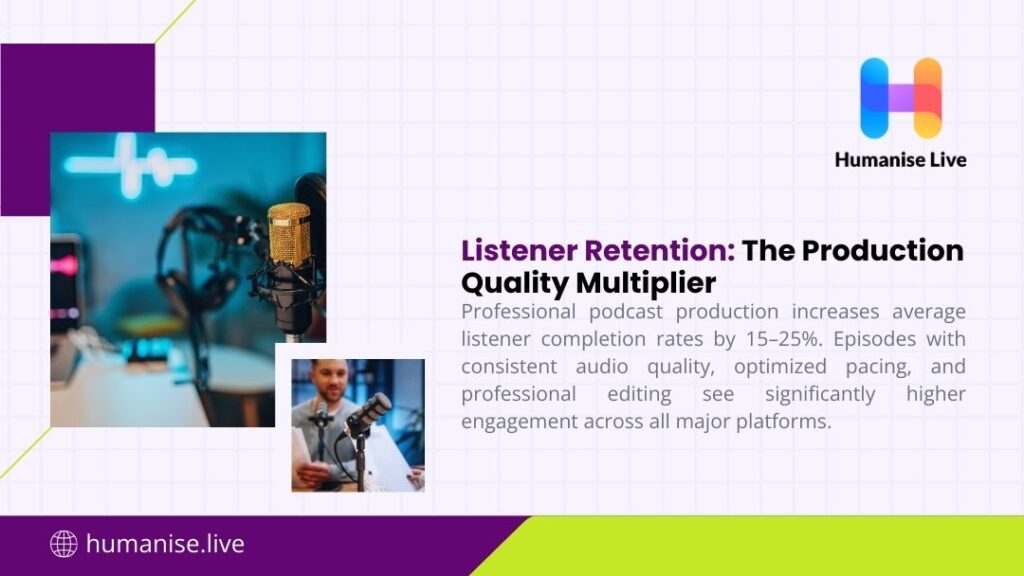
What the data does show is that production quality and structure influence listener engagement, which in turn affects growth. Research on podcast performance metrics indicates that episodes with clear audio, steady pacing, and professional post-production tend to hold listener attention longer than episodes with uneven sound or inconsistent editing. Industry benchmarks place average podcast completion rates between 50% and 70%, with well-produced shows more likely to sit at the upper end of that range.
Higher completion rates matter because listening platforms use engagement signals, including how long listeners stay with an episode, to inform recommendation and discovery systems.
This does not mean outsourcing guarantees growth. Strong production cannot compensate for weak ideas or unclear positioning. It does mean that outsourced podcast production removes technical friction that often limits momentum, especially as episode volume increases.
So here’s the thing. Outsourcing is neither good nor bad by default. It becomes useful when production quality, time efficiency, and audience trust carry more weight than maintaining hands-on control over every technical step.
Cost considerations in real terms
Outsourcing podcast production costs vary because production scopes vary. Editing alone differs from full-service support that includes publishing, monitoring, and promotion.
| Cost type | Typical range | What it includes |
| Per episode | $100–$500 | Editing, leveling, and delivery |
| Monthly retainer | $500–$3,000 | Full production workflow |
| Add-on services | Variable | Transcription, video, clips |
What’s often ignored is internal cost. Time spent editing displaces strategy, outreach, and growth work. Outsourcing makes that trade-off visible rather than hidden.
How outsourcing supports long-term strategy
Outsourcing integrates well with growth planning. Edited audio feeds and podcast audio editing workflows. Video versions support podcast video editing for YouTube and social platforms. Performance tracking improves through podcast monitoring tools. Accessibility improves via podcast transcription service integration. Distribution stabilizes through podcast hosting services with managed uploads.
When shows target business audiences, b2b podcast production workflows benefit from consistency and analytics. Monetization becomes clearer through podcast advertising support and sponsor-ready formats.
Outsourcing also strengthens marketing execution. Repurposed clips align with podcast marketing services strategies. Guest outreach improves when production feels reliable.
Choosing the right production partner
Selection matters. A podcast production company should understand your voice, industry, and release cadence. Transparent processes reduce friction. Clear revision terms protect creative intent. Experience with remote podcast recording prevents technical mishaps.
Geographic relevance also plays a role. Some teams prefer regional familiarity through options, while others prioritize global reach.
Where This Leaves Your Podcast Next
Outsourcing podcast production pros and cons point to one conclusion: podcasts don’t fail because creators lack passion. They fail because systems collapse under pressure.
If your goal is consistency, credibility, and longevity, outsourcing can remove friction without erasing your voice. If you want hands-on control, in-house production still has a place.
For purpose-driven creators who want their message to sound as strong as it feels, Humanise Live supports podcasts from planning through publishing while keeping storytelling human and intentional. Their approach blends structure with flexibility, helping shows stay consistent without becoming mechanical.
If your podcast deserves to sound as serious as the ideas behind it, explore how Humanise Live can support your production and help your show grow without burning you out.
