
Outsourcing podcast production costs isn’t a fixed number you can plug into a spreadsheet and forget. They shift based on how your show runs, who touches it, and how much risk you’re willing to carry yourself. This guide breaks down what actually affects pricing, where budgets quietly leak, and how to choose a setup that doesn’t collapse six months in.
What Is Outsourcing Podcast Production?
Outsourcing podcast production means handing off some, or all, of the work behind your show to people who do this for a living. Instead of recording, editing, fixing audio problems, writing show notes, uploading files, and chasing deadlines yourself, you pay a specialist team or individual to handle it.
For some shows, outsourcing starts small. A podcast editor cleans up audio files and sends them back ready to publish. For others, it’s full-service podcast production, where planning, recording logistics, post-production, distribution, and even performance tracking sit outside the business.
The reason outsourcing podcast production costs exists at all is simple: consistency is hard to maintain when production competes with everything else on your plate. Outsourcing doesn’t remove work; it moves it to people whose job is to absorb that workload without missing a beat.
Outsourcing Podcast Production Costs: Pros and Cons
Before deciding, most teams want a clear-eyed view of the pros and cons. Here’s how outsourcing podcast production costs usually shakes out in practice.
| Aspect | Pros | Cons |
| Time | Frees up internal hours | Requires coordination |
| Quality | More consistent audio | Less hands-on control |
| Scalability | Easier to grow output | Higher cash spend |
| Reliability | Fewer missed releases | Dependence on partners |
The biggest advantage is focus. When production moves off your desk, you regain time for content, guests, and strategy. That’s often why shows last longer when they outsource. The downside is loss of immediacy. Changes need communication. Feedback loops matter.
From a cost perspective, outsourcing podcast production costs feels heavier at first because they’re visible line items. DIY costs hide in hours lost and stress accumulated. Over time, many teams realise the real question isn’t how much it costs, but what breaks if we don’t do this properly.
What actually drives podcast production costs
Podcast production costs aren’t arbitrary. They reflect labor, expertise, and the complexity of your show. Episode length matters, but so does format. Interview shows with remote guests need track recording and cleanup. Narrative shows demand scripting, sound design, and heavier audio editing. Video adds another layer, from cameras to rendering time.
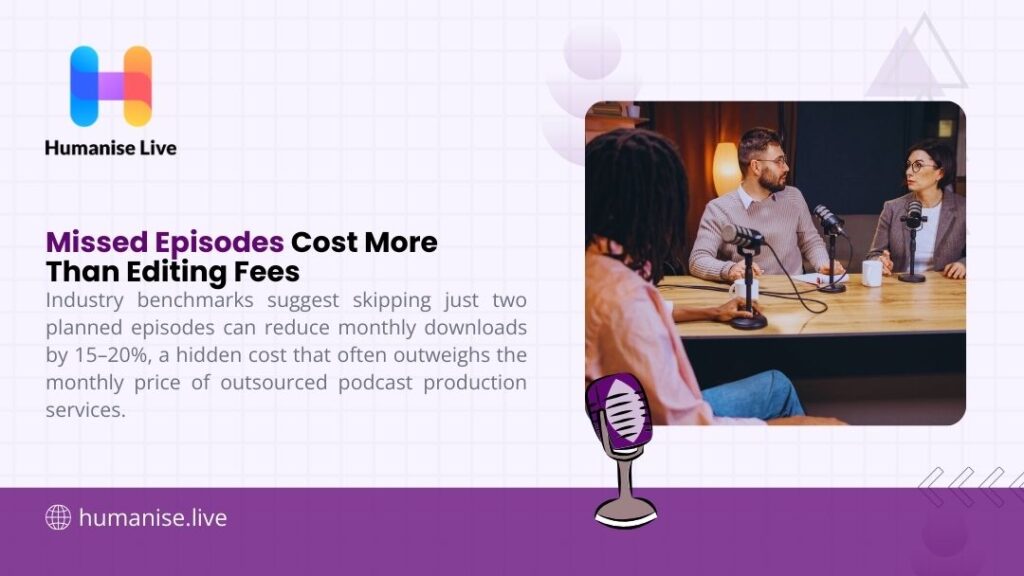
Frequency also pushes costs up or down. A weekly release reduces the podcast cost per episode when billed monthly, while irregular schedules usually cost more per episode. Finally, experience plays a role.
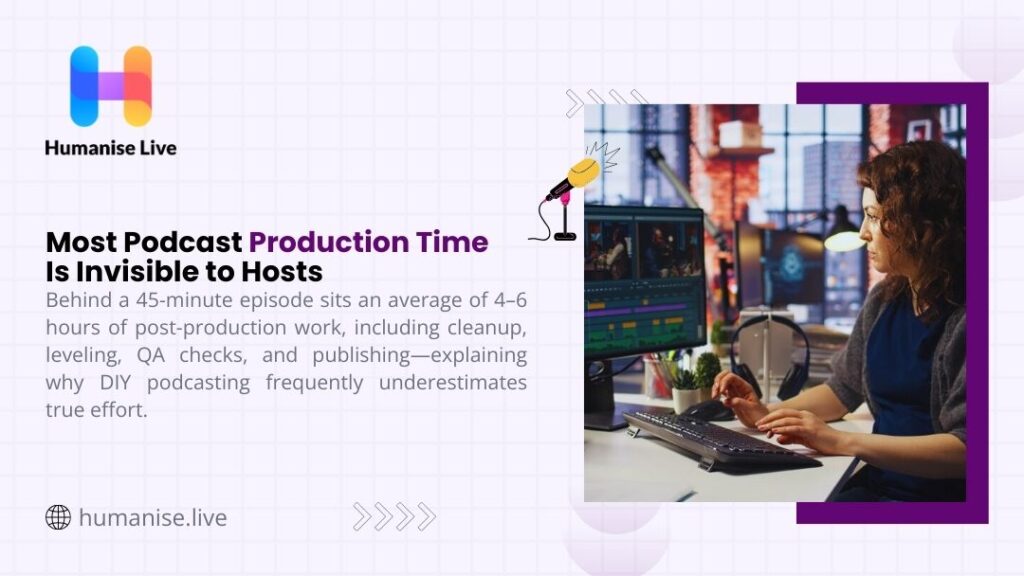
Time is the quiet multiplier. The Podcast Host estimates that many creators spend roughly 3 to 5 hours editing an hour-long episode, even before you count admin work like uploads, show notes, and scheduling. That labor explains why podcast production rates don’t stay low for long.
Freelancers, agencies, or DIY: where the money goes
Before looking at numbers, it helps to understand who you’re paying and what risk you’re taking on.
Some creators prefer freelancers, while others rely on agencies. If you’re comparing a freelance podcast editor vs podcast agency, the difference usually comes down to flexibility, cost control, and how much production risk you want to manage. Each option moves costs around rather than eliminating them. Here’s how the trade-offs usually look in practice:
| Approach | Typical cost range | What you gain | What you absorb |
| DIY | Software + time | Full control, lowest cash spend | Time loss, learning curve, inconsistency |
| Freelancer | $50–$500 per episode | Flexibility, specialist skills | Single point of failure |
| Agency | $1,500–$7,000+ per month | Process, backup, strategy | Higher fixed spend |
DIY often feels cheapest until time enters the equation. Editing, troubleshooting, and publishing quietly consume hours every week. Freelancers reduce that load but rely on one person’s availability. Agencies cost more upfront, yet they absorb operational risk by design.
That said, “agency” can mean two very different models: traditional retainers, or lean providers that price per episode and sit much closer to senior freelance rates. This is why many teams ask whether they need a production company for a podcast only after a missed deadline or a broken episode goes public.
Typical outsourcing podcast production costs by service level
Outsourcing podcast production costs usually fall into predictable tiers. These ranges reflect current market pricing across freelance and agency models.
| Service scope | Typical price range | Common use case |
| Editing only | $50–$500 per episode | Early-stage or hobby shows |
| Full production (lean / boutique providers) | £200–£400 per episode | Charities, SMEs, purpose-driven teams |
| Producer + editing | $300–$1,200 per episode | Growing podcasts |
| Traditional agency retainers | $1,500–$7,000+ per month | Enterprise brands, complex shows |
Not all podcast production companies operate on high monthly retainers. Some independent or boutique providers deliver full-service production on a per-episode basis, with pricing closer to senior freelance rates while still offering structured workflows and delivery backup.
Humanise Live sits in this category, publishing per-episode pricing (basic editing and distribution from £200 per episode, full service from £300 per episode) and offering the first episode free so teams can test quality, process, and communication before committing to ongoing outsourcing podcast production costs.
How to Choose a Podcast Production Provider
Choosing a podcast production provider isn’t about finding the cheapest quote or the most polished website. It’s about alignment. The right provider understands your format, your audience, and the role the podcast plays in your business. The wrong one delivers technically correct episodes that never quite move the needle.
Before comparing prices, it helps to look at how providers actually operate. Some focus on editing volume. Others build shows as long-term assets. Those differences affect both cost and outcomes. Here’s how the main options typically stack up.
| Evaluation factor | What to look for | Why it matters |
| Process clarity | Documented workflow | Reduces missed steps |
| Communication | Clear feedback cycles | Prevents rework |
| Experience | Relevant show types | Avoids learning curves |
| Scalability | Team depth | Supports growth |
| Accountability | Named producer or PM | Ensures ownership |
A strong provider won’t rush you into a package. They’ll ask uncomfortable questions about goals, audience, and timelines. That friction early on usually saves money later. If every answer sounds rehearsed, that’s a signal.
After onboarding, the real test is consistency. The best providers don’t just deliver episodes. They keep the release machine running when things get messy.
What Questions Should You Ask Before Hiring a Podcast Production Company?
Before signing anything, it’s worth slowing the process down and asking questions that go beyond pricing. The goal isn’t to catch a provider out. It’s to understand how they behave when things don’t go to plan, because eventually, something won’t.
| Question to ask | What you’re really checking | Why it matters |
| Who will manage my podcast day to day? | Clear ownership | Prevents quality drift |
| How do you handle feedback and revisions? | Process maturity | Avoids surprise costs |
| What happens if an episode runs late? | Contingency planning | Protects the release schedule |
| How do you manage guest issues or no-shows? | Operational experience | Reduces disruption |
| What’s included vs billed separately? | Pricing transparency | Controls budget creep |
| How do you measure a podcast’s success? | Strategic alignment | Shows long-term thinking |
| Can I speak to an existing client? | Real-world proof | Confirms reliability |
| What happens if we pause or scale? | Contract flexibility | Supports growth changes |
If a provider answers these questions clearly and without defensiveness, that’s usually a good sign. If they brush them off or steer the conversation back to features and pricing, it’s worth pausing before you commit.
Factors That Impact Your Production Costs
Podcast production costs don’t rise randomly. They respond to pressure points in the workflow. Format plays a major role. A simple interview show costs less to maintain than a scripted or narrative series. Recording method matters too. Remote track recording adds complexity compared to in-studio sessions. Video introduces an entirely separate post-production layer.
Frequency and turnaround expectations also push costs up or down. Weekly shows allow batching. Irregular schedules usually cost more because teams can’t plan efficiently. Here’s how these variables typically influence spend.
| Cost driver | Low impact | High impact |
| Episode format | Single host | Multi-guest narrative |
| Recording setup | One track | Multi-track remote |
| Output frequency | Monthly | Weekly or more |
| Post-production | Light cleanup | Sound design & video |
| Review cycles | One pass | Multiple stakeholders |
Costs rise fastest when several high-impact factors stack at once. That’s why two podcasts with the same episode length can have very different budgets. Understanding these drivers helps teams control spend without cutting quality in the wrong places.
Hidden costs people forget to budget for
Most podcast budgets miss the same things. Hosting fees seem small until archives grow. Music licensing is often overlooked until a takedown notice appears. Transcription looks optional until accessibility or SEO becomes a priority.
Then there’s revision time. Stakeholder feedback loops stretch post-production. Last-minute changes burn hours. None of this shows up in the headline podcast production pricing.
The highest hidden cost, though, is attention. Time spent managing production is time not spent refining topics, developing partnerships, or monetizing. That opportunity cost rarely appears in budgets, yet it’s often the reason shows stall.
Outsourcing vs building in-house in 2026
As shows mature, teams often consider bringing production in-house. The logic sounds solid: control, speed, and lower long-term cost. The reality is more complex.
In-house production adds salaries, benefits, equipment, and training. The U.S. Bureau of Labor Statistics lists median pay for broadcast, sound, and video technicians at $56,600 (May 2024), before you add overhead and the cost of management. Outsourcing podcast production costs remains variable, which matters when priorities shift. Here’s how the two models typically compare:
| Factor | Outsourcing | In-house |
| Fixed costs | Low | High |
| Scalability | Flexible | Limited |
| Expertise | Broad | Dependent on hires |
| Risk | Shared | Fully internal |
In-house production adds salaries, benefits, equipment, and training. A single podcast producer’s salary can exceed an annual agency retainer. Outsourcing podcast production costs remains variable, which matters when priorities shift. That flexibility is why many organizations stick with outsourcing longer than planned.
What you get when you pay more
Higher podcast production costs don’t just buy polish. They buy stability. Experienced producers prevent technical issues before recording. Editors maintain consistent sound across episodes. Project managers keep schedules intact even when guests cancel or files arrive late.
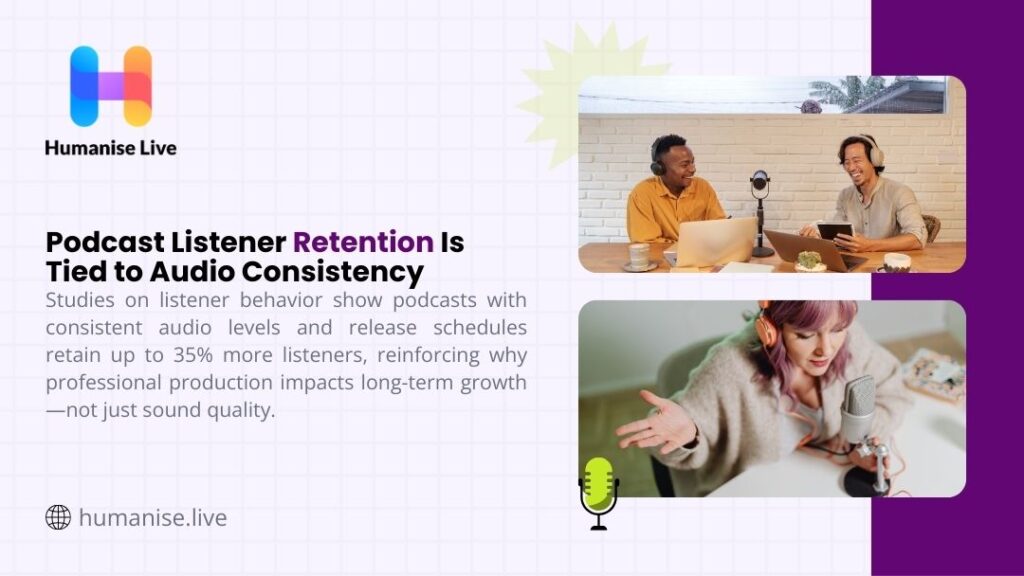
Quality also affects perception. Poor audio drives listeners away faster than weak content. Consistent delivery builds trust. Those outcomes don’t appear on invoices, yet they shape whether a show grows or quietly fades.
Cost scenarios: real-world examples
Budgets make more sense when tied to real use cases.
| Scenario | Setup | Approximate annual cost |
| Solo monthly show | Freelance editing | $1,500–$3,000 |
| Weekly business podcast | Agency production | $30,000–$45,000 |
| Seasonal branded series | Project-based outsourcing | $8,000–$20,000 |
Each example answers a different version of how much to start a podcast or the cost to produce a podcast. None is wrong. They simply reflect different goals and constraints.
Comparing service depth across providers
Pricing alone doesn’t explain value. Scope does.
| Feature | Freelancer | Small agency | Full production team |
| Audio editing | Yes | Yes | Yes |
| Guest coordination | No | Sometimes | Yes |
| Video production | Rare | Sometimes | Yes |
| Strategy & reporting | No | Limited | Yes |
The deeper the service stack, the less internal coordination a client needs. That reduction in friction often matters more than raw cost.
Planning a realistic budget
A realistic budget starts with intent, not averages. Decide how often you’ll publish, what formats you need, and how polished the show must sound. Then compare that against podcast production services pricing in your market.
Some teams start lean and add services later. Others invest upfront to avoid rework. Both approaches work when expectations match spend.
Understanding tasks like podcast editing and distribution helps clarify why certain costs exist and where compromise is safe.
Why outsourcing still makes sense in 2026
Tools keep improving, yet outsourcing podcast production costs remains justified because expertise compounds.
Producers recognize patterns. Editors spot issues before listeners do. Systems prevent missed releases. In a crowded market, consistency separates shows that grow from those that vanish.
Listener research continues to show that audio quality and reliability drive retention. Outsourcing directly supports both.
A smarter way to handle outsourcing podcast production costs
Outsourcing podcast production costs shouldn’t feel like a gamble. When structured properly, it’s a controlled investment in consistency, quality, and time.
For organizations that want reliable output without building an internal production department, working with a specialist partner makes sense. A team like Humanise Live is positioned as a lower-overhead alternative to traditional agency retainers, with published per-episode pricing (£200–£300/episode) and a first episode free model that reduces risk for charities and purpose-led teams.
If you’re weighing whether outsourcing fits your next season, start with one episode. Measure the difference. Then decide what level of support actually earns its keep.
