
Choosing between an audio podcast and a video podcast is not about chasing the newest format. It is about choosing the format your audience will actually use, trust, and come back to. In this article, we will discover the real audio podcast vs video podcast pros and cons, compare cost, reach, production time, audience behavior, and brand value, and help you decide whether audio, video, or a hybrid format makes the most sense for your show.
Quick Answer: Audio Podcast or Video Podcast?
Choose an audio podcast if you want a lower-cost, easier-to-produce show that people can listen to while driving, walking, working, or commuting. Choose a video podcast if your brand needs more visual trust, YouTube discovery, social media clips, and face-to-face authority. Choose both if you want one strong recording to become an audio episode, a full video, short clips, a transcript, an article, a newsletter, and a campaign asset.
| Best Choice | Use It When |
| Audio podcast | You want intimacy, lower cost, faster production, and screen-free listening |
| Video podcast | You want visibility, YouTube reach, social clips, and a stronger personal connection |
| Hybrid podcast | You want the most value from each recording and have a clear repurposing plan |
Audio Podcast vs Video Podcast Pros and Cons
The debate around audio podcast vs video podcast pros and cons usually starts with cost, but that is only part of the story. Audio is often cheaper, faster, and easier to sustain. Video can reach more platforms, create stronger social clips, and help people see the humans behind the message.
For a purpose-driven brand, the better choice depends on your audience, your topic, your host, your budget, and how you plan to use each episode after it goes live. If your audience prefers to listen during a commute, walk, workout, or workday, an audio podcast may be the most natural fit. If your team wants YouTube discovery, short-form video, visible thought leadership, and more assets for social media, a video podcast may carry more value.
| Factor | Audio Podcast | Video Podcast |
| Best fit | Screen-free listening, interviews, education, stories, thought leadership | YouTube, social media clips, brand visibility, founder presence, event-led content |
| Cost | Usually lower | Usually higher |
| Production time | Faster to record, edit, and publish | More time needed for camera, lighting, editing, captions, and thumbnails |
| Guest comfort | Easier for camera-shy guests | Better for confident speakers and visual topics |
| Discoverability | Strong through podcast apps, SEO pages, newsletters, and communities | Strong through YouTube, Shorts, Reels, TikTok, LinkedIn, and search |
| Trust factor | Builds trust through voice, consistency, and story | Builds trust through voice, facial expression, body language, and visual presence |
| Repurposing value | Transcripts, blogs, audiograms, quotes, newsletters | Clips, reels, Shorts, full video, transcript, blog, quote cards, paid ads |
| Best starting point | Great for lean teams and early-stage shows | Best when visibility and content volume matter |
If you are still at the planning stage, podcast launch support can help you think through the basics before you choose a format.
What Is an Audio Podcast?
An audio podcast is a show made mainly for listening. It may be an interview, a solo episode, a panel conversation, a documentary-style series, a branded show, or a teaching format. The listener does not need to watch anything to understand the episode.
So, are podcasts audio only? Not always. That used to be the default meaning, but the industry has changed. A podcast can now be audio-only, video-first, or both. Still, audio remains the classic format because it fits into everyday life so well.
When people ask, what does audio only mean? The answer is simple. Audio only means the episode is designed so the listener can follow the full story without a screen. There may be a cover image, show notes, transcript, or social clip attached to it, but the core experience is listening.
That matters more than many teams realize. A well-produced audio podcast can travel with the listener. It can sit beside someone on a morning walk, in a car, on a train, or during a quiet hour at work. For sensitive stories, nonprofit campaigns, founder interviews, and expert-led conversations, audio can feel personal without feeling performative.
Good audio still needs care. Poor sound can make even a brilliant guest hard to listen to. Clean recording, clear structure, careful editing, and professional mixing all shape how credible the show feels. That is why many teams use specialist audio podcast editing instead of treating editing as an afterthought.
A SiriusXM Media analysis on audio and video podcasts also shows why audio should not be dismissed. The company reported that 92% of its podcast consumers still listen to podcasts via audio, with 53% described as audio-only listeners.
For brands, that is the reminder: video may be louder in the marketing conversation, but audio still carries a huge share of actual consumption.
Pros of an Audio Podcast
Audio has a quiet advantage: it asks less from the audience. They do not need to sit still, look at a screen, or give the show their full visual attention.
| Benefit | Why It Matters |
| Lower barrier to start | Teams can launch without a full studio, camera setup, or heavy production process |
| Easier for guests | Camera-shy guests often speak with more honesty and less self-consciousness |
| Stronger listening flexibility | People can listen while driving, walking, cooking, working, or commuting |
| More intimate feel | Voice can build trust without the pressure of visual performance |
| Better for sensitive stories | Charity, advocacy, mental health, and social-impact topics may feel safer in audio |
| Faster production | Editing and publishing are usually simpler than a full video workflow |
| Strong distribution | A podcast RSS feed can reach Apple Podcasts, Spotify, Amazon Music, and other listening platforms |
For example, a charity campaign podcast may work better as audio because the people involved can speak freely without worrying about how they look on camera. That kind of comfort can lead to stronger stories, and stronger stories are what people remember.
For a team that wants a simple, reliable publishing process, podcast hosting and distribution can keep the technical side under control.
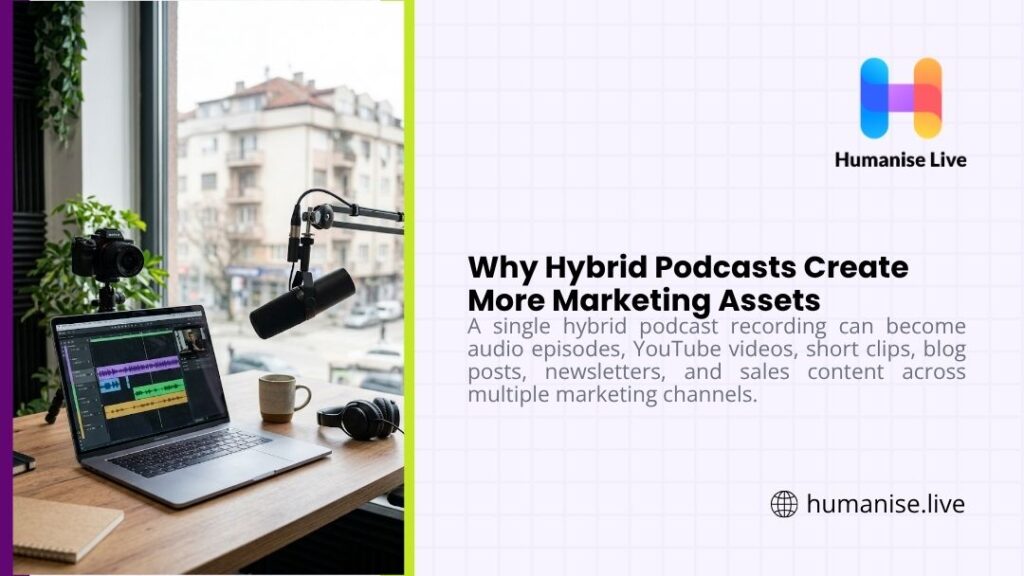
Cons of an Audio Podcast
Audio is powerful, but it can be harder to make visible. That matters when your marketing team also needs clips, social posts, and quick moments that stop someone mid-scroll.
| Limitation | What It Means in Practice |
| Fewer visual assets | Audio does not naturally create face-led clips for YouTube Shorts, Reels, TikTok, or LinkedIn |
| Harder to show visual ideas | Product demos, screen shares, event footage, and design reviews may lose impact |
| Slower social discovery | Audio may need stronger support from newsletters, guests, the community, and SEO content |
| Less immediate brand visibility | The audience hears the people behind the brand but does not see them |
| Analytics can feel scattered | Downloads, streams, follows, and completion data may vary across platforms |
| More reliant on consistency | Audio growth often builds over time rather than through one viral moment |
The fix is not to abandon audio. The fix is to support it properly with transcripts, show notes, campaign assets, and a clear distribution plan. If the audio version does not work on its own, the show is not ready to call itself a podcast.
What Is a Video Podcast?
A video podcast is a podcast with a filmed version of the episode. It can be recorded in a studio, at an event, in an office, on location, or remotely with guests in different places. The full episode may live on YouTube, Spotify, a website, or a private member platform. Shorter clips may appear on Instagram Reels, TikTok, YouTube Shorts, LinkedIn, and paid campaigns.
Edison Research reported in The Infinite Dial 2025 that YouTube is the most-used service among U.S. weekly podcast listeners, with 33% using it most often.
Can a podcast be a video? Yes. A podcast can have video as long as it still works as an episodic show with a clear topic, audience, structure, and release rhythm. A random one-off interview on camera is not automatically a podcast. A video podcast needs the same editorial discipline as an audio podcast: a reason to exist, a consistent format, a defined audience, and a repeatable production process.
This also answers questions like are podcasts video or audio, is a podcast a video, and can podcasts have video. Podcasts can be audio, video, or both. The format is less important than the promise you make to the audience. If people know what the show gives them and why they should come back, you are on the right track.
The video does add extra pressure. The host needs to think about camera presence, lighting, posture, facial expression, background, framing, and visual pace. The editor also needs to shape both the conversation and the viewing experience. That is where dedicated video podcast editing can make the difference between a conversation that was merely recorded and a show that feels worth watching.
Pros of a Video Podcast
Video helps people see the humans behind the message. For purpose-driven brands, that can make a big difference because trust often grows faster when the audience can see who is speaking.
| Benefit | Why It Matters |
| Stronger visual trust | Viewers can see facial expression, confidence, warmth, and body language |
| Better social media assets | One episode can become clips, Reels, Shorts, teasers, and paid social content |
| YouTube discovery | Video gives the show another route through search, recommendations, and full-episode viewing |
| Higher brand presence | Founders, experts, and campaign leaders become more visible to the audience |
| Useful for education | Product demos, visual examples, live reactions, and event clips are easier to understand |
| Stronger repurposing value | A filmed episode can become audio, video, clips, transcripts, blogs, and newsletters |
| Good for event-led content | Panels, interviews, keynotes, and live discussions can become long-term marketing assets |
For example, a B2B SaaS founder may choose video because buyers often want to see the person explaining the product, not just hear a voice. A clear clip on LinkedIn can build confidence before someone ever visits the website. For teams that host or attend events, event capture and livestream production can turn a moment in the room into long-term content.
Cons of a Video Podcast
Video can be excellent, but it is less forgiving. Weak sound, poor lighting, awkward framing, or slow editing can make a thoughtful conversation feel less credible than it deserves.
| Limitation | What It Means in Practice |
| Higher production cost | Cameras, lights, storage, editing, captions, thumbnails, and graphics can add cost |
| Longer editing process | Video needs visual pacing, cuts, captions, aspect ratios, and platform-specific exports |
| More pressure on guests | Some guests become stiff or guarded when the camera is on |
| More planning required | Backgrounds, framing, lighting, internet stability, and file backups all need attention |
| Brand risk | Poor visuals can weaken trust, especially for serious or mission-led organizations |
| Harder to sustain | A complex workflow can slow the show down after the first few episodes |
| Easy to overproduce | Teams can spend too much time on appearance and not enough on the actual conversation |
That is not a failure of the video. It is a failure of production design. A podcast should not become so complicated that the team quietly stops talking about the next episode.
If video is the right format, build a process that your team can repeat. If the process feels too heavy, start with professional podcast editing and add video layers once the show has a stable rhythm.
The Real Difference Between Audio and Video Podcasting
The real difference between audio and video podcasting is not just the camera. It is the way people discover, consume, and remember the content. Audio is built around voice. The listener notices pace, warmth, tone, questions, silence, music, and sound quality. A good audio podcast can feel close and calm because there is no visual noise. The listener can focus on what is being said.
Video adds another layer. The viewer sees the host, guest, setting, reactions, expressions, gestures, and energy in the room. That can create trust quickly, especially for founders, experts, campaign leaders, and brands with a strong human story. It can also create more pressure, because weak lighting, poor framing, or awkward camera presence may distract from a strong message.
Podcast consumption has become more fluid. According to Edison Research’s Gabriel Soto, there’s room for both video and audio in the world of podcasts. That quote matters because it moves the conversation away from a false choice. The question is no longer only audio vs video podcast. The better question is, which version should lead, and how should each episode work harder across platforms?
For remote teams, this choice also affects the recording process. A video podcast can work even when guests are in different cities or countries, but it requires a stronger setup. Camera angles, microphones, internet stability, guest prep, and backup files all play a role. Remote podcast recording becomes much smoother when these elements are handled properly, helping teams maintain a professional result without being in the same room.
Audio vs Video Podcast: Which Format Works Best for Your Goal?
A format decision should start with the job the podcast needs to do. Some shows need depth. Some need to reach. Some need trust. Some need a steady flow of social media content. Some need all of that, but not on day one.
| Goal | Better Format | Why It Works |
| Launch fast with a lean team | Audio | The workflow is simpler and easier to sustain |
| Reach people during commutes or workdays | Audio | Listeners do not need to watch a screen |
| Interview sensitive or camera-shy guests | Audio | The conversation can feel safer and more relaxed |
| Build YouTube visibility | Video | The platform supports search, recommendations, and full episodes |
| Create social media clips | Video | Short clips are easier to cut from filmed conversations |
| Build founder or expert visibility | Video | The audience sees the person behind the ideas |
| Explain visual topics | Video | Demos, screens, products, and events are easier to show |
| Turn one episode into many assets | Hybrid | Audio, video, clips, transcript, blog, newsletter, and campaign assets can come from one recording |
For many organizations, the hybrid route gives the best return. Record a strong video conversation. Publish the audio as a podcast. Use the video for YouTube and clips. Turn the transcript into a blog or article. Pull the best ideas into a newsletter. That approach helps each episode work harder without forcing the team to create from scratch every week. The idea of getting more value from each podcast episode aligns directly with this approach.
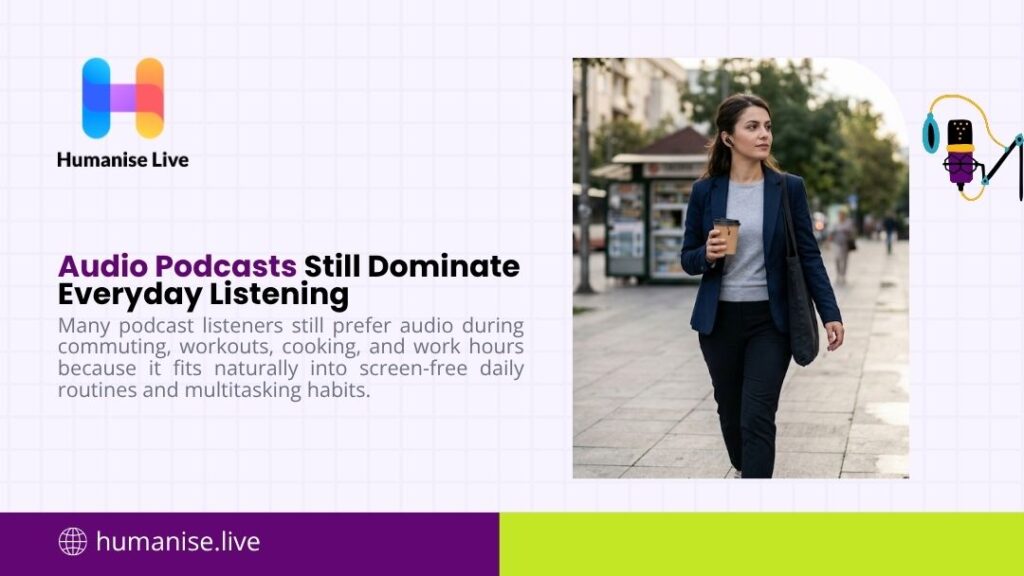
Are Podcasts Still Popular If Everyone Talks About Video?
Yes, podcasts are still popular. What has changed is how people consume them. Some listeners still prefer classic audio. Others watch full episodes on YouTube. Many people move between formats depending on the show, the moment, and the device in front of them.
Pew Research Center’s podcast fact sheet also reported that 32% of U.S. adults get news from podcasts at least sometimes, up from 22% in 2020. That growth matters for brands and organizations because podcasts are no longer a fringe content channel. They are part of how people learn, follow experts, hear stories, and build trust with voices they respect.
The rise of video does not mean audio is dead. It means the podcast has become more flexible. A person may watch a clip on LinkedIn, save the full episode for YouTube, and later listen to the audio version on a walk. The same show can meet the same person in several contexts.
That is why podcast growth now needs more than publish and hope. It needs positioning, repurposing, distribution, and a channel plan. For teams that want help beyond the recording itself, podcast marketing services can turn a good episode into a campaign with a longer shelf life.
Should Your Business Podcast Be Audio Only, Video Only, or Both?
A business podcast should serve the audience first and the content calendar second. If the show is built only to feed social media, it may become shallow. If it is built only around long conversations with no distribution plan, it may become invisible. The best format sits between audience behavior and business goals.
For a new show with a small team, audio-first can be the sensible choice. It allows the host to build confidence, test topics, improve the format, and create consistency before adding cameras. This works well for internal experts, nonprofit leaders, first-time hosts, and teams that want to learn as they go.
For instance, a sustainability nonprofit may begin with an audio podcast because its guests include activists, researchers, community partners, and beneficiaries who may not want to appear on camera. The same organization can still create quote cards, transcripts, blog posts, and newsletter stories from each episode.
For a brand that already has strong spokespeople, regular campaigns, and a need for visible authority, video may make sense from the start. A sustainability founder, B2B SaaS leader, charity CEO, or social-impact investor may gain more from being seen as well as heard.
A founder-led tech-for-good company may take the opposite route. If its buyers need to understand a product, trust the leadership team, and see clear explanations before they book a call, video can support both education and conversion. Short clips from a video podcast can also give the sales and marketing team useful material for LinkedIn, email, and retargeting campaigns.
For many established teams, both formats are worth it. A filmed conversation can become a video podcast, an audio-only podcast, short clips, a transcript, a search-friendly article, newsletter content, and paid amplification.
That is especially useful for marketing and communications leaders at purpose-driven SMEs, scale-ups, charities, NGOs, tech-for-good firms, social-impact funds, and founder-led brands. Those are exactly the audiences Humanise Live says it serves through done-for-you podcast, video, event, and campaign support.
If the show is tied to sales, trust, authority, or sector education, B2B podcast production can help shape the format around a clear commercial and editorial purpose.
The Hybrid Podcast Model: Record Once, Publish Everywhere
The smartest podcast teams rarely treat one episode as one asset. They treat it as a source recording. Here is how it works. A team records one strong conversation on video. The full video is on YouTube or Spotify. The audio goes to podcast platforms. Short clips go to social media. The transcript supports accessibility and search. The best ideas become an article, newsletter, quote cards, speaker notes, sales enablement content, or event follow-up material.
This does not mean every show needs to become a giant production machine. It means the recording should be planned with reuse in mind. If a guest says something powerful, that moment should be easy to find. If the host explains a useful framework, that section should be cut into a clip. If the episode answers common customer questions, the transcript can support a blog or FAQ page.
This is where a done-for-you model can remove the stress. Humanise Live’s client brief describes an end-to-end service that can cover strategy, recording, editing, promotion, guest management, content strategy, and community engagement. The company also highlights content repurposing and campaign management as core services, alongside podcast production, video and reels, event capture, livestreams, and speaker representation.
That combination matters because the work does not stop when someone presses record. In many cases, the real value appears after the episode is edited, packaged, distributed, clipped, captioned, promoted, and measured.
The best podcast workflow is not record, upload, forget. It is record once, shape it properly, and let the right people meet it in the format they prefer.
For teams that want one partner to handle the full process, done-for-you podcast production may be a better fit than trying to manage strategy, guests, files, edits, clips, and publishing across several freelancers.
Audio Podcast vs Video Podcast Cost, Time, and Production Needs
The cost difference between audio and video depends on the quality level, but video almost always adds more moving parts. The question is not only can we afford it? The better question is, can we sustain it without lowering quality?
| Production Area | Audio Podcast | Video Podcast |
| Core equipment | Microphone, headphones, recording software, quiet room | Cameras, microphones, lights, tripods, backdrop, storage, and recording software |
| Recording setup | Remote call, studio, or simple in-office setup | Studio, remote video setup, live event space, office setup, or on-location shoot |
| Host prep | Topic brief, questions, guest research, sound check | Topic brief, questions, guest research, sound check, camera check, lighting check |
| Editing needs | Clean-up, cuts, pacing, mix, intro, outro, levels | Audio mix, video cuts, captions, color, graphics, thumbnails, aspect ratios |
| Publishing | Podcast host, RSS feed, show notes, transcript | YouTube, Spotify video, podcast host, clips, captions, thumbnails, social posts |
| Repurposing | Transcript, blog, audiogram, quote cards, newsletter | Shorts, reels, full video, transcript, blog, quote cards, paid ads |
| Main risk | Low discoverability without promotion | Heavy workflow if the team lacks a process |
| Best support | Audio editing, hosting, and monitoring | Video editing, clip production, campaign management |
A lean audio podcast may be enough when the goal is to publish consistent thought leadership and build a loyal audience. A video podcast may justify the extra cost when the same recording can support YouTube, social media, sales conversations, website pages, event campaigns, and paid promotion. For budget planning, information on podcast production costs can help teams understand what drives the pricing.
Common Mistakes When Choosing Between Audio and Video
Most podcast problems do not start in the edit. They start when the format is chosen for the wrong reason.
| Mistake | Why It Hurts | Better Move |
| Choosing video only because it feels current | The team may end up with a workflow that it cannot sustain | Choose a video only if it supports the audience, topic, and content plan |
| Ignoring audio quality in a video podcast | Viewers may forgive average visuals, but they rarely forgive bad sound | Treat audio as the foundation of every podcast format |
| Recording video with no clip strategy | The team gets a long episode, but misses the social media value | Plan short-form moments before recording |
| Forcing camera-shy guests on screen | Guests may give guarded, flat, or nervous answers | Match the format to guest comfort and topic sensitivity |
| Skipping transcripts and captions | The show loses accessibility, search value, and repurposing potential | Use transcripts, captions, and show notes as part of the workflow |
| Measuring the wrong numbers | A charity show and a B2B lead-gen show should not judge success the same way | Tie metrics to the purpose of the show |
| Making the setup too complex | Production becomes stressful and inconsistent | Build a repeatable process that the team can maintain |
The smartest move is not always the most ambitious one. It is the one your team can repeat without losing quality, energy, or the human reason the podcast exists in the first place.
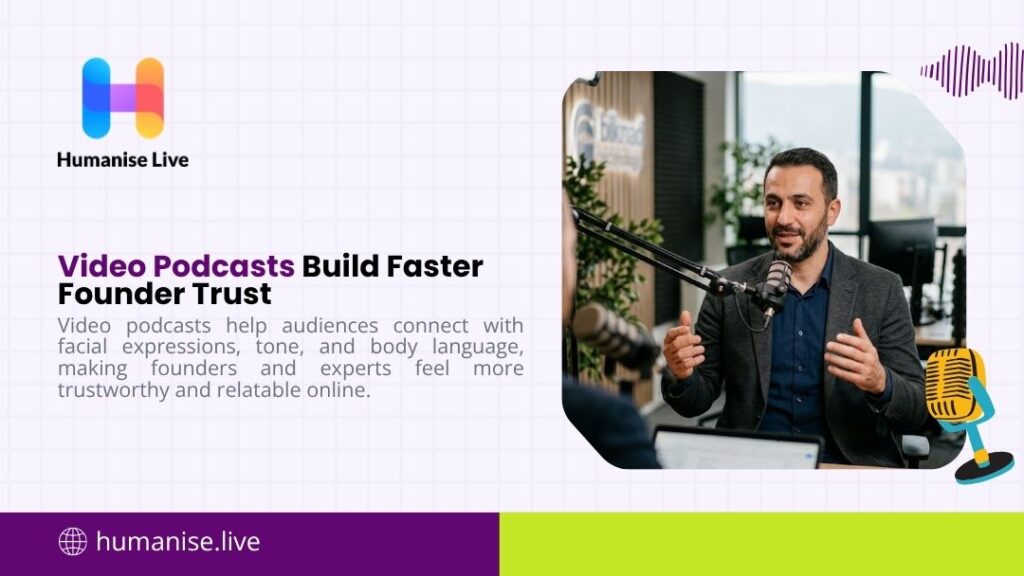
FAQs
Are podcasts audio-only?
No. Podcasts are not only audio anymore. An audio-only podcast is still the classic format, but many modern podcasts also have a video version on YouTube, Spotify, or a brand website.
Can a podcast be a video?
Yes. A podcast can be a video if the episode is filmed and published for people to watch. Many shows now publish both a video podcast and an audio podcast from the same recording.
Are podcasts live?
Some podcasts are live, especially event podcasts, livestreamed interviews, and audience Q&A shows. Most podcasts are recorded first, edited, and then published later. That gives the team more control over sound, structure, pacing, and quality.
Which is better: audio podcast or video podcast?
Audio is usually better for ease, intimacy, lower cost, and screen-free listening. Video is usually better for visibility, social media, YouTube discovery, and visual trust. For many brands, the best option is a hybrid workflow that records video, publishes audio, and repurposes the strongest moments across channels.
A Better Way to Start: Choose the Format You Can Sustain
The best podcast format is not the one that looks most impressive in a planning meeting. It is the one your team can produce well, repeat often, and improve over time. For purpose-driven brands, charities, founders, B2B teams, sustainability organizations, NGOs, and thought leaders, the choice should come back to one question: how can this show help the right people trust the message?
If audio helps your audience listen with more focus, start there. If video helps your audience see the people and purpose behind the work, build for that. If one recording can become a podcast episode, video, clips, transcript, article, and campaign, the hybrid route may give the strongest return.
If you are still not sure whether your show should start as audio, video, or both, you do not have to decide in a vacuum. Humanise Live offers a first episode produced 100% free, which gives teams a low-risk way to test the format, hear the quality, and understand what a proper production workflow can feel like before committing.
If you want to test your idea before you commit to a full production plan, you can start with expert podcast production support and build the format around your audience, your message, and the content your team can sustain.
